Funding News
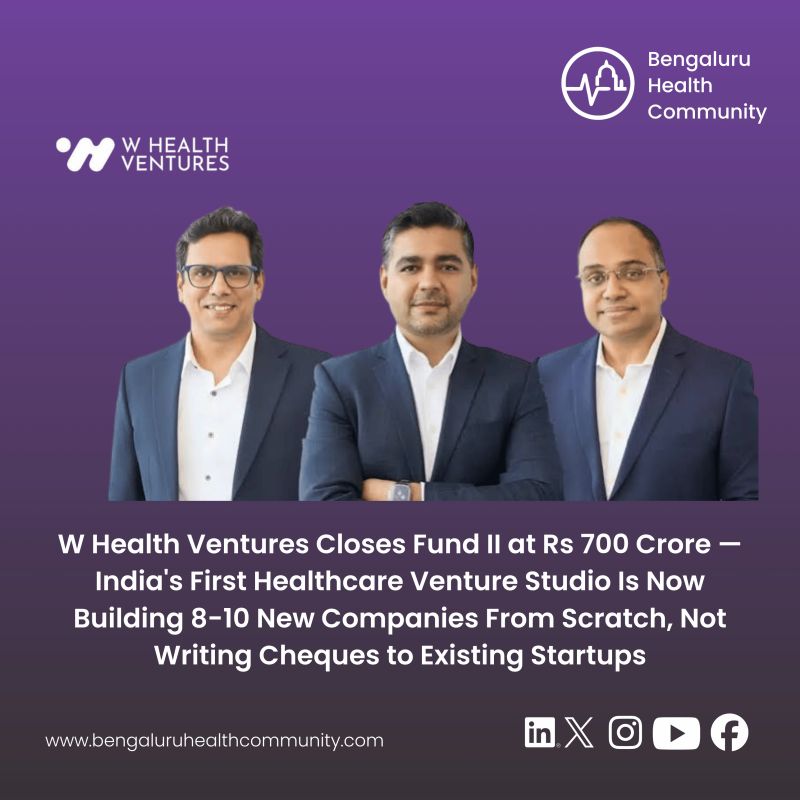
W Health Ventures Closes Fund II at Rs 700 Crore — India's First Healthcare Venture Studio Is Now Building 8-10 New Companies From Scratch, Not Writing Cheques to Existing Startups
By Mustafa Shariff, Editor in Chief · September 09,2026 · 2 mins read
Summary
- W Health Ventures Closes Fund II at Rs 700 Crore — India's Healthcare Venture Studio Will Build 8-10 Companies From Pre-Idea to Category Leaders
- W Health Ventures closed Fund II at Rs 700 crore (oversubscribed from Rs 630 crore target) on September 8, 2026 — India's first healthcare company creation fund will build 8-10 single-specialty healthcare companies over 4 years via its venture studio model.
"India is at an inflection point in healthcare as the rising demand and constrained supply create a structural mismatch. That mismatch is where lasting businesses are built. What keeps most people away isn't the opportunity — it's how hard healthcare is to build in. We think that is precisely where the value is. We would not write cheques to existing startups. Instead, we will exclusively focus on company creation. We identify a clinical gap, spend 12-18 months pressure-testing the opportunity, recruit an exceptional founding team, and then build with them from the pre-idea stage to category leadership. That is the only model that consistently closes the gap between what India's healthcare system needs and what it gets."
W Health Ventures, India's first healthcare company creation fund, closed its second fund at Rs 700 crore on September 8, 2026 — exceeding its initial target of Rs 630 crore in an oversubscription that carries a specific market signal: at a moment when conventional healthtech VC deal count in India has fallen (from 78 deals in 2024 to 54 deals in 2025), limited partners chose a healthcare venture studio over a traditional cheque-writing VC fund.
What W Health Ventures Actually Does — and Why It Is Different
W Health Ventures is not a venture capital fund in the conventional sense. It does not receive pitch decks from existing founders, evaluate existing companies, and write investment cheques. It does the opposite: it identifies clinical problems that existing healthcare companies are not solving, evaluates whether a new company can solve them, and then builds that company itself.
Managing Partner Pankaj Jethwani was explicit on this point in the Fund II announcement: 'We would not write cheques to existing startups. Instead, we will exclusively focus on company creation.' The process: WHV's 50-person in-house team — comprising physicians, operators, and technologists — identifies structural gaps in India's healthcare delivery system. The team then spends 12-18 months pressure-testing whether the gap represents a viable company-building opportunity: is the market large enough, is the problem solvable with current technology, is there a reimbursement or payment pathway, and is there a team configuration that could build and scale the solution? Only after this evaluation does WHV recruit a founding team and begin building the company.
The Venture Studio Thesis: Why Company Creation Rather Than Company Funding
The conventional VC model for healthcare has a structural challenge that W Health's approach addresses directly: by the time a healthcare company is visible to early-stage VCs, it has already made the hardest and most consequential decisions — what clinical problem to focus on, what care model to build, what regulatory pathway to pursue, what reimbursement model to use. These founding decisions are made by founders who are often clinical experts but rarely experienced healthcare business builders, without access to the 12-18 months of operational research that W Health's team conducts before a company is created.
The venture studio model inserts the experienced healthcare operational team into the company formation moment — ensuring that every company WHV creates starts with a rigorously validated clinical problem, a commercially feasible business model, and a founding team recruited for the specific skills that company needs. This is why WHV describes itself as building companies 'from pre-idea to category leadership' — the idea itself comes from the WHV team, not from an external founder who brings the pitch.
Fund II Portfolio: Two Companies Already Built
Fund II has already built two companies. Everhope Oncology — built in partnership with Narayana Health — is building coordinated, patient-centric cancer care infrastructure. In a country where oncology care is fragmented across diagnostic centres, oncologists, surgical hospitals, and radiation facilities that rarely communicate with each other, Everhope is building the coordinated cancer care model. Everbright Health, launched in the US, is developing treatments for treatment-resistant depression — the estimated 30% of depression patients who do not respond to conventional antidepressant medications.
Fund I Portfolio: A Track Record of Company Creation
Fund I's portfolio demonstrates the company creation thesis at work across multiple healthcare categories. Wysa (mental health AI), BeatO (diabetes management), Mylo (maternal and baby care), Reveal (healthcare technology services), BabyMD (paediatric care), Elevate Now (GLP-1 weight management for Indian patients), Nivaan (interventional pain clinics), and Hoola Health (children's health developmental care) — eight companies across eight distinct healthcare categories, collectively reaching 25 million patients. Each of these companies was built around a documented clinical gap rather than an existing entrepreneur's idea.
Fund II Structure and LP Profile
Fund II is registered as a Category II Alternative Investment Fund (AIF) with SEBI — marking W Health's transition from a US-domiciled fund (Fund I) to an India-registered structure. LPs include family offices and institutions from both India and the US interested in the Indian healthcare opportunity. The fund focuses approximately two-thirds of its capital on India-domiciled companies targeting the Indian market, with one-third reserved for companies operating in the US-India healthcare corridor. Typical investment ticket: Rs 30-50 crore per company.
BHC Perspective
At Bengaluru Health Community, W Health Ventures' Rs 700 crore Fund II close is the most important India healthcare fund close of 2026 — and the most strategically distinctive. The venture studio model creates companies that BHC's mentors, HMEP graduates, and ecosystem members can join, collaborate with, and build partnerships with. For BHC's physician-entrepreneurs and clinical founders — W Health's model of partnering physicians and technologists to build single-specialty companies from identified clinical gaps is the most relevant company-building framework in India's healthcare ecosystem today. W Health's Bengaluru office is a natural point of engagement for BHC's community.
Frequently Asked Questions
Q: What did W Health Ventures close and when?
A: Fund II closed at Rs 700 crore (~$73-84M) on September 8, 2026 — oversubscribed from its initial Rs 630 crore target. Registered as Category II AIF with SEBI (previous Fund I was US-based). Managing Partner: Pankaj Jethwani.
Q: What is W Health's company creation model?
A: India's first healthcare venture studio: a 50-person in-house team of physicians, operators, and technologists identifies clinical gaps, spends 12-18 months pressure-testing viability, then recruits a founding team to build the company. Does NOT write cheques to existing startups. Fund II will build 8-10 companies over 4 years (Rs 30-50 crore each, 2-3 per year).
Q: What companies has W Health already built?
A: Fund II: Everhope Oncology (coordinated cancer care, with Narayana Health) + Everbright Health (treatment-resistant depression, US). Fund I portfolio: Wysa, BeatO, Mylo, Reveal, BabyMD, Elevate Now, Nivaan, Hoola Health — collectively reaching 25 million patients.