Funding News
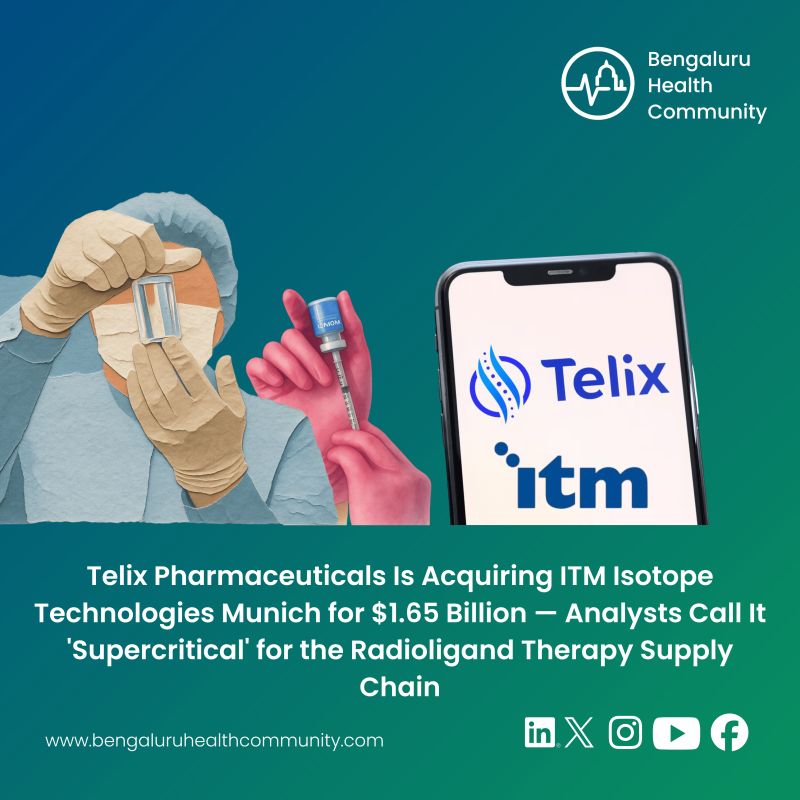
Telix Pharmaceuticals Is Acquiring ITM Isotope Technologies Munich for $1.65 Billion — Analysts Call It 'Supercritical' for the Radioligand Therapy Supply Chain
By Mustafa Shariff, Editor in Chief · September 24 ,2026 · 2 mins read
Summary
- Telix Pharmaceuticals Acquires ITM Isotope Technologies for $1.65B — 'Supercritical' Vertical Integration in Radioligand Therapy Supply Chain
- Telix Pharmaceuticals agreed to acquire ITM Isotope Technologies Munich for $1.65B (September 20, 2026) plus $700M milestones — securing its lutetium-177 isotope supply chain for radioligand therapy pipeline. William Blair analysts: 'supercritical' and 'extremely bullish.'
Australian biotech Telix Pharmaceuticals announced on September 20, 2026 that it has agreed to acquire privately-held ITM Isotope Technologies Munich SE — a leading European producer of medical isotopes — for $1.65 billion upfront, plus up to $700 million in milestone payments, and assuming more than $300 million of ITM's debt at closing. Analysts at William Blair called the deal 'supercritical' and described themselves as 'extremely bullish' on the combined entity's growth prospects. ITM's lead asset: a lutetium-177-based radiopharmaceutical for solid tumors with FDA approval milestones embedded in the deal's contingent payments. The acquisition secures Telix's isotope supply chain for its therapeutic radioligand pipeline — addressing the most fundamental constraint on radioligand therapy commercialisation: isotope availability.
Melbourne-based Telix Pharmaceuticals announced on September 20, 2026 that it has agreed to acquire ITM Isotope Technologies Munich SE — a privately-held German company and one of Europe's leading producers of medical isotopes for radiopharmaceutical applications — for approximately $1.65 billion on a cash-free, debt-free basis. Telix will also assume more than $300 million of ITM's existing debt at closing, and could pay up to $700 million in contingent milestone payments, primarily linked to FDA approvals for ITM's lead asset.
Why Isotope Supply Chain Is the Critical Bottleneck
Radioligand therapy — which uses a radioactive isotope linked to a targeting molecule to deliver precise radiation directly to cancer cells — has emerged as one of oncology's most commercially significant treatment categories. Novartis's Pluvicto (lutetium-177-PSMA-617) for prostate cancer generated over $1.5 billion in 2025 sales and recently expanded its eligible patient population. Eli Lilly is developing radioligand therapies through its acquisition of Point Biopharma. Dozens of clinical-stage radioligand programmes across oncology are heading toward commercialisation in the next five years.
The fundamental constraint on all of these programmes is the same: lutetium-177, the radioactive isotope that powers the therapeutic component of most radioligand therapies, is a specialty product that requires nuclear reactor production infrastructure. ITM Isotope Technologies Munich is one of the few companies globally with the production capacity and regulatory approvals to supply clinical-grade lutetium-177 at commercial scale. By acquiring ITM, Telix is securing the isotope supply chain for its own pipeline while simultaneously positioning to supply other radioligand therapy developers.
Analysts React: 'Supercritical' and 'Extremely Bullish'
William Blair analysts, writing in a note published Monday morning following the deal announcement, called the acquisition 'supercritical' for Telix's strategic positioning and described themselves as 'extremely bullish' on the growth prospects of the combined Telix-ITM entity. The 'supercritical' characterisation captures the supply chain logic of the deal: in a market where dozens of radioligand therapy products are approaching commercialisation, ownership of a major lutetium-177 production platform creates structural competitive advantages that are extraordinarily difficult for competitors to replicate.
India's Radioligand Context
For BHC Media's India audience: India's radioligand therapy ecosystem is early-stage but directionally significant. Immuneel Therapeutics (BHC Media July 17 edition) and the CLAA regulatory framework for CAR-T and gene therapies (BHC Media July 7 edition) are building India's advanced therapeutic infrastructure. Radioligand therapies represent the next frontier — and India's ability to manufacture and supply lutetium-177 domestically (the Department of Atomic Energy has lutetium-177 production capability at BARC, Trombay) positions India as a potential supplier to the global radioligand therapy market.
BHC Perspective
At Bengaluru Health Community, the Telix-ITM deal is the most strategically important oncology infrastructure deal of September 2026. The acquisition of a medical isotope production company by a radioligand therapy company is a blueprint for the supply chain integration that will define competitive advantage in oncology's fastest-growing treatment modality. For BHC founders in oncology technology, radiopharmaceuticals, or nuclear medicine — this deal defines the vertically integrated model that will dominate radioligand therapy commercialisation.
FAQs
Q: What is the Telix-ITM deal?
A: Telix Pharmaceuticals (Australia, ASX: TLX) agreed to acquire ITM Isotope Technologies Munich SE (Germany) for $1.65B (September 20, 2026), plus up to $700M milestones and assuming $300M+ of ITM debt. Secures lutetium-177 isotope supply chain for Telix's radioligand therapy pipeline.
Q: Why do analysts call it 'supercritical'?
A: Lutetium-177 — the isotope powering most radioligand therapies (including Novartis's Pluvicto) — requires specialty nuclear reactor production. ITM is one of the few global producers at commercial scale. Owning this supply chain creates structural advantages for Telix as dozens of radioligand therapies approach commercialisation simultaneously.
Q: What is radioligand therapy?
A: A cancer treatment that links a radioactive isotope (like lutetium-177) to a molecule that targets cancer cells — delivering precise radiation directly to tumors while minimising impact on healthy tissue. Novartis's Pluvicto for prostate cancer is the commercial proof-of-concept, generating $1.5B+ in 2025 sales.