Funding News
TDB Backs Bengaluru's Peptris with ₹86 Cr to Fast-Track AI-Designed Drug Candidates
By Mustafa Shariff, Editor in Chief · October 19, 2026 · 2 mins read
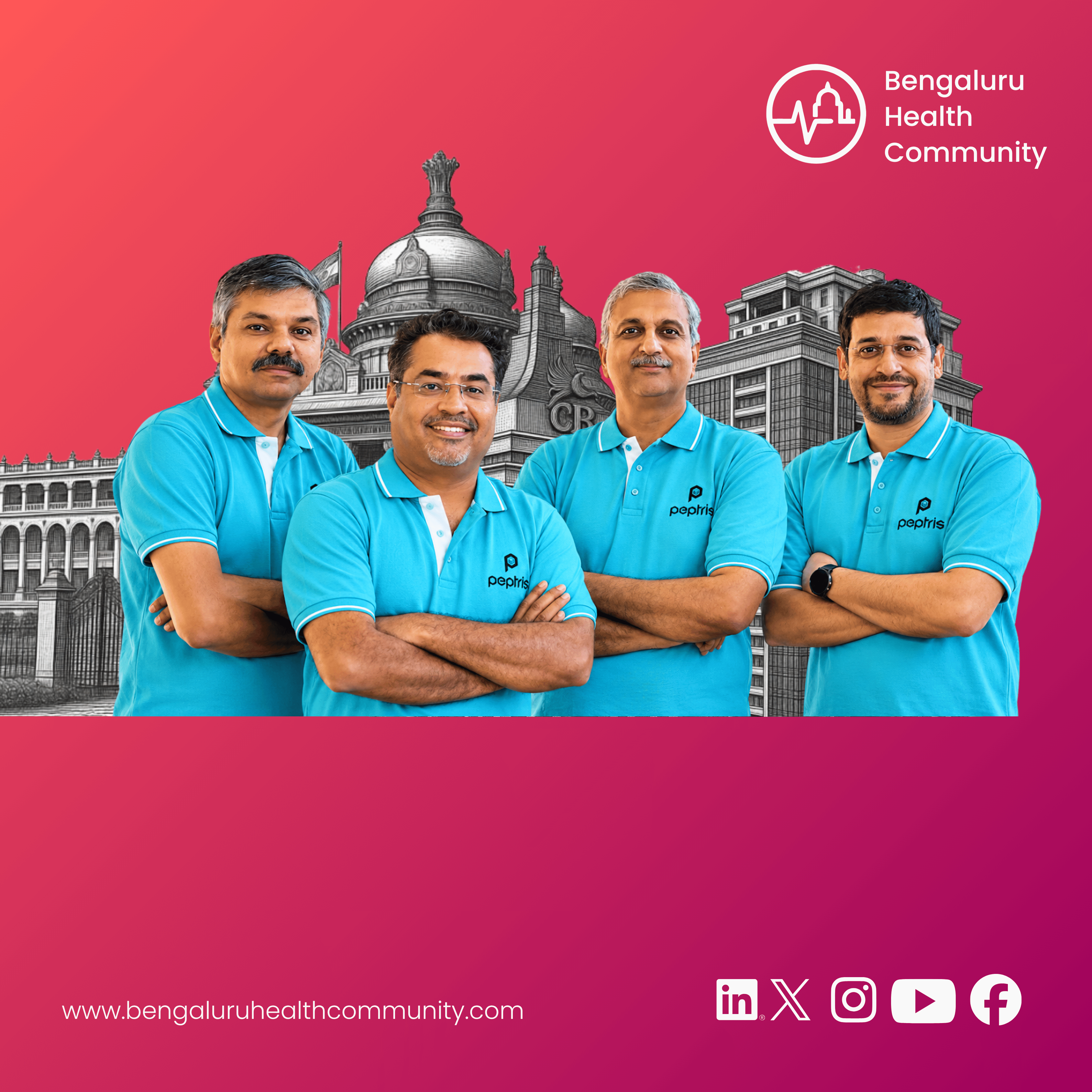
Summary
- TDB-DST invests ₹86 crore in Bengaluru's Peptris for AI drug discovery VIGOR program
- India's Technology Development Board has signed an ₹86 crore RDI agreement with Bengaluru-based Peptris Technologies to advance its VIGOR program — four AI-designed drug candidates targeting cancer, hair loss, neuropathy, and diabetes toward clinical readiness.
"VIGOR turns four AI-generated drug leads — for cancer, hair loss, neuropathy, and diabetes — into clinical-ready candidates."
On 12 October 2026, India's Technology Development Board (TDB), operating under the Department of Science and Technology (DST), signed an ₹86 crore Research, Development & Innovation (RDI) collaboration agreement with Peptris Technologies Pvt Ltd, a Bengaluru-based AI drug discovery company. The funds will be deployed to advance Peptris's VIGOR program, which encompasses four AI-designed drug candidates, from their current pre-clinical stage toward IND-enabling (Investigational New Drug-enabling) studies that qualify them for first-in-human clinical trials.
About Peptris and the VIGOR Program
Peptris is a Bengaluru-based biotechnology company that uses artificial intelligence to design and optimise drug molecules. Its platform generates drug candidates computationally — selecting molecular structures with predicted efficacy, selectivity, and safety profiles — and then synthesises and tests them in the lab to validate the predictions. The VIGOR program has four active AI-designed candidates: one for neuromuscular disorders and oncology, one for androgenic alopecia (hair loss), one for peripheral neuropathy, and one for type 2 diabetes. Each candidate has already moved partway through preclinical development, meaning they have been synthesised and are undergoing early pharmacological and toxicology studies. The ₹86 crore will fund the remaining IND-enabling package for all four.
Why TDB Is Investing
TDB functions as a bridge between government R&D funding and market-ready innovation. Its RDI agreements are conditional — money flows against milestone delivery, not upfront — which means Peptris must demonstrate scientific progress at defined checkpoints to access the full ₹86 crore. For the government, the strategic logic is clear: India has a world-class generic pharmaceutical manufacturing base but a thin pipeline of novel drug candidates. AI drug discovery offers a potential shortcut — compressing the early discovery phase from years to months and dramatically reducing the cost of generating viable lead molecules. A successful VIGOR outcome would put India on the global map for novel drug origination, not just manufacturing.
AI Drug Discovery: The Global Context
The AI drug discovery sector has seen explosive investment globally. Companies like Insilico Medicine (which achieved the first AI-designed drug to reach Phase II trials), Isomorphic Labs (a DeepMind spin-off), and Recursion Pharmaceuticals have demonstrated that AI can materially accelerate the lead identification and optimisation steps of drug discovery. India has been a late entrant into this space — most domestic biotech funding has gone to biosimilars, generics, and drug delivery platforms rather than AI-first discovery. The Peptris/TDB deal signals a policy-level commitment to changing that.
Bengaluru's Emerging Biotech Ecosystem
Bengaluru is becoming the focal point for India's biotech ambitions. The city hosts Biocon (India's largest biopharmaceutical company), a cluster of CDMO and CRO operations, IISc's biosciences programmes, and a growing cohort of AI and data science talent that is increasingly being recruited by life sciences companies. Peptris is one of a handful of Bengaluru startups at the intersection of AI and drug discovery — a category that also includes companies like Aganitha and Aqemia (with Indian operations). The TDB investment validates this cluster and could catalyse further private capital into the space.
What Happens Next
With ₹86 crore secured, Peptris will expand its research team, accelerate synthesis and testing cycles for all four VIGOR candidates, and engage CROs (Contract Research Organisations) for the formal IND-enabling toxicology and pharmacokinetics studies. If the program proceeds on schedule, at least one of the four VIGOR candidates could file an IND (or Indian equivalent) application within two to three years. That would make Peptris one of a very small number of Indian companies to have taken a novel, AI-designed drug candidate to the clinical threshold from a Bengaluru base.
BHC Perspective
This deal is directly relevant to the Bengaluru Health Community's mission. As a community that has relationships across the Bengaluru health ecosystem — from hospitals to investors to founders — BHC sees the Peptris-TDB partnership as a landmark moment for local biotech ambition. AI drug discovery is no longer a Silicon Valley story; it is increasingly a Bengaluru story. Members of BHC's healthcare startup ecosystem, particularly those in digital health, diagnostics, and therapeutics, should be paying close attention to the VIGOR program and to the broader TDB funding landscape for early-stage biotech companies.
Frequently Asked Questions
Q: What is the VIGOR program and what diseases does it target?
A: VIGOR is Peptris's AI drug discovery program comprising four drug candidates: one targeting neuromuscular disorders and cancer, one for androgenic alopecia (hair loss), one for peripheral neuropathy, and one for type 2 diabetes. All four were designed computationally using Peptris's AI platform and are undergoing pre-clinical development. The ₹86 crore TDB funding will advance them toward IND-enabling studies required before human trials.
Q: How does TDB's RDI agreement structure work?
A: TDB (Technology Development Board) provides milestone-linked funding under its RDI (Research, Development & Innovation) agreements — meaning Peptris must achieve defined scientific milestones to access each tranche of the ₹86 crore. This is not a pure grant; it is a structured government-backed financing mechanism designed to de-risk early-stage R&D while maintaining accountability for deliverables.
Q: Is Peptris the first Indian AI drug discovery company to receive government RDI funding?
A: Peptris is among the early recipients of a large TDB RDI commitment specifically for AI-first drug discovery. While the government has backed biotech R&D through various schemes (BIRAC, DBT grants, PRIP), a dedicated ₹86 crore RDI deal for an AI drug discovery startup of this scale is relatively rare in India. It signals a deliberate policy shift toward novel drug origination.
Q: When could Peptris's VIGOR candidates enter human trials?
A: IND-enabling studies — the package of toxicology, pharmacokinetics, and safety studies needed to file an IND (Investigational New Drug) application — typically take 18 to 36 months to complete once adequately funded. If Peptris deploys the TDB capital efficiently, the earliest VIGOR candidates could be ready to file for first-in-human trials within two to three years, placing them at clinical stage by approximately 2028-2029.