News
Remidio Has Been Granted a US Patent for Wearable 3D Eye Imaging — Five Eye Exams in One Device, No Dilation Needed, and a New Chapter for Oculomics
By Mustafa Shariff, Editor in Chief · August 31,2026 · 2 mins read
Summary
- Remidio Granted US Patent 12,611,103: Bengaluru's Wearable 3D Eye Imaging Device Combines Five Exams in One, No Dilation Required
- Bengaluru-based Remidio Innovative Solutions received US Patent No. 12,611,103 for a wearable 3D eye imaging device (smart glasses/VR headset format) combining slit lamp, fundus, and anterior segment imaging with no pupil dilation — advancing its Oculomics retinal screening strategy.
"What used to need a slit lamp, an ophthalmoscope, and several specialised exams can now fit into something worn like a pair of glasses. We are not just making the equipment smaller — we are changing where an eye exam can happen. A specialist eye examination that previously required a clinic, a trained technician, and multiple instruments can now be done at a primary health centre, a community screening camp, or even a patient's home. That is the kind of innovation we are always chasing at Remidio — technology that pushes the boundaries of care."
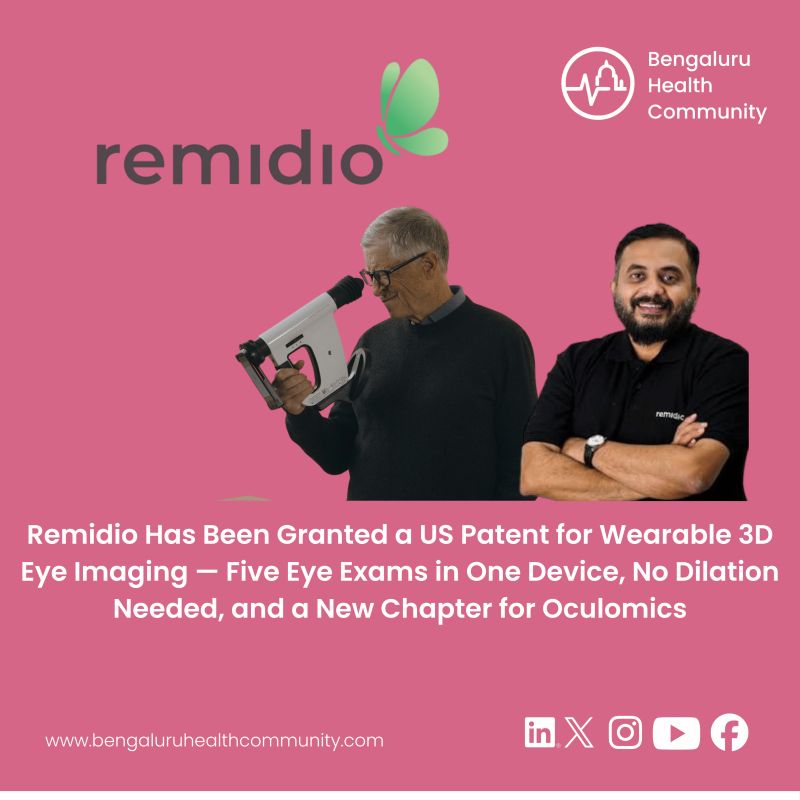
Remidio Innovative Solutions Pvt. Ltd, the Bengaluru-based medical technology company known for its AI-powered retinal imaging platforms, has been granted US Patent No. 12,611,103 for a 3D eye imaging technology built around a wearable form factor — smart glasses or a VR-style headset — rather than the bulky desk-mounted instruments that conventional ophthalmic examination equipment requires.
What the Patent Covers
The patented device combines five or more separate ophthalmic examinations into a single wearable instrument. Slit lamp imaging — conventionally performed at a large desk-mounted instrument that the patient sits facing — enables examination of the eye's anterior structures (cornea, iris, lens, anterior chamber) at high magnification. Fundus imaging — examination of the retina at the back of the eye — conventionally requires either a separate fundus camera or an indirect ophthalmoscope with specific patient positioning. Diffused anterior segment imaging adds a further modality.
Combining all of these modalities in a single wearable eliminates the need for multiple instruments, the patient positioning requirements of each, and the specialist training required to operate each instrument independently.
Dilation-Free: The Key Clinical Advance
A critical feature of the patented technology is its ability to perform these examinations without requiring pupil dilation. Conventional fundus examination typically requires pupil-dilating eye drops (mydriasis), which take 15-30 minutes to take effect, cause photophobia and blurred near vision for 4-6 hours afterwards, and require the patient to avoid driving post-examination. The dilation step limits the practicality of fundus screening in community, primary care, and outreach settings.
Remidio's patented device uses infrared illumination — which the pupil does not constrict in response to as it does with visible light — enabling clear imaging of the fundus through a naturally sized pupil. The elimination of the dilation step makes the device practical for rapid community-level screening without the logistical burden and patient-time impact of conventional dilation-dependent fundus examination.
Oculomics: The Eye as a Systemic Disease Window
Remidio's patent directly advances its Oculomics strategy. Oculomics is the emerging field that uses ocular imaging — particularly retinal imaging — to detect and monitor systemic diseases beyond the eye itself. The retina is the only place in the body where blood vessels can be directly examined non-invasively and without radiation, providing a unique window into vascular health. Growing clinical evidence supports the retinal vasculature as a biomarker for cardiovascular disease risk, diabetic complications, kidney disease progression, and neurodegenerative conditions including Alzheimer's disease.
Remidio already has regulatory approvals and clinical validation for its AI-based retinal screening tools for diabetic retinopathy in India — a CDSCO-approved, offline AI-enabled fundus imaging device that BHC Media covered in the June 30 edition (Roche's Artelus Drishti collaboration). The wearable 3D imaging patent extends this retinal screening capability into a significantly more deployable hardware form factor.
BHC Perspective
At Bengaluru Health Community, Remidio's US patent is the most important Bengaluru medtech IP milestone of August 2026. A Bengaluru company with CDSCO-approved AI retinal screening tools, a collaboration with Roche, and now a US patent for wearable multi-modal ophthalmic imaging — this is a company building a comprehensive and defensible retinal health technology platform. For BHC founders in ophthalmic technology, AI diagnostics, or community health screening — Remidio's patent portfolio is the benchmark for what depth of medtech IP in India looks like.
Frequently Asked Questions
Q: What is Remidio's US patent?
A: US Patent No. 12,611,103 for a 3D eye imaging technology in wearable form factor (smart glasses or VR-style headset), combining slit lamp, fundus, and anterior segment imaging in one device without requiring pupil dilation — using infrared illumination instead of conventional visible light.
Q: What is Oculomics?
A: The emerging field using ocular (retinal) imaging to detect and monitor systemic diseases — cardiovascular disease, diabetes, kidney disease, neurodegenerative conditions — beyond the eye itself. The retina's directly visible vasculature provides a non-invasive, radiation-free window into systemic vascular and neurological health.
Q: Who is Remidio?
A: Bengaluru-based medical technology company developing AI-powered retinal imaging platforms for diabetic retinopathy screening and Oculomics. Has CDSCO-approved offline AI retinal screening devices, collaboration with Roche (Artelus Drishti), and now US Patent No. 12,611,103 for wearable 3D eye imaging.