News
Piramal Pharma's FY2026 Annual Report: ₹8,869 Crore Revenue, A Net Loss From CDMO Destocking, and a $90 Million Bet on the Recovery
By Mustafa Shariff, Editor in Chief · July 13,2026 · 2 min read
Summary
- Piramal Pharma FY2026: ₹8,869 Crore Revenue, CDMO Destocking Drives Net Loss, $90M Expansion and Zero OAI Quality Record
- Piramal Pharma's FY2026 Annual Report shows ₹8,869 crore revenue, a ₹325.94 crore net loss from CDMO destocking, zero OAI across all USFDA inspections, and a $90M sterile injectables expansion commitment for FY27 recovery.
"FY2026 was a transitional year, shaped by external disruptions and certain business-specific factors. Despite these challenges, we exited the year on a stronger note across all three businesses with improved execution and better visibility of future growth. With the CDMO customer destocking cycle ending and RFPs increasing since late 2025, all three businesses are well-positioned to deliver growth in FY27, accompanied by accelerated growth in EBITDA and PAT."
Piramal Pharma Limited released its Annual Report for FY2026 on July 7, 2026, presenting a year that the company's Chairperson Nandini Piramal characterised accurately and concisely as transitional — shaped by external disruptions and business-specific factors that created a financially difficult year while leaving the company's strategic capabilities and operational quality record stronger than before.
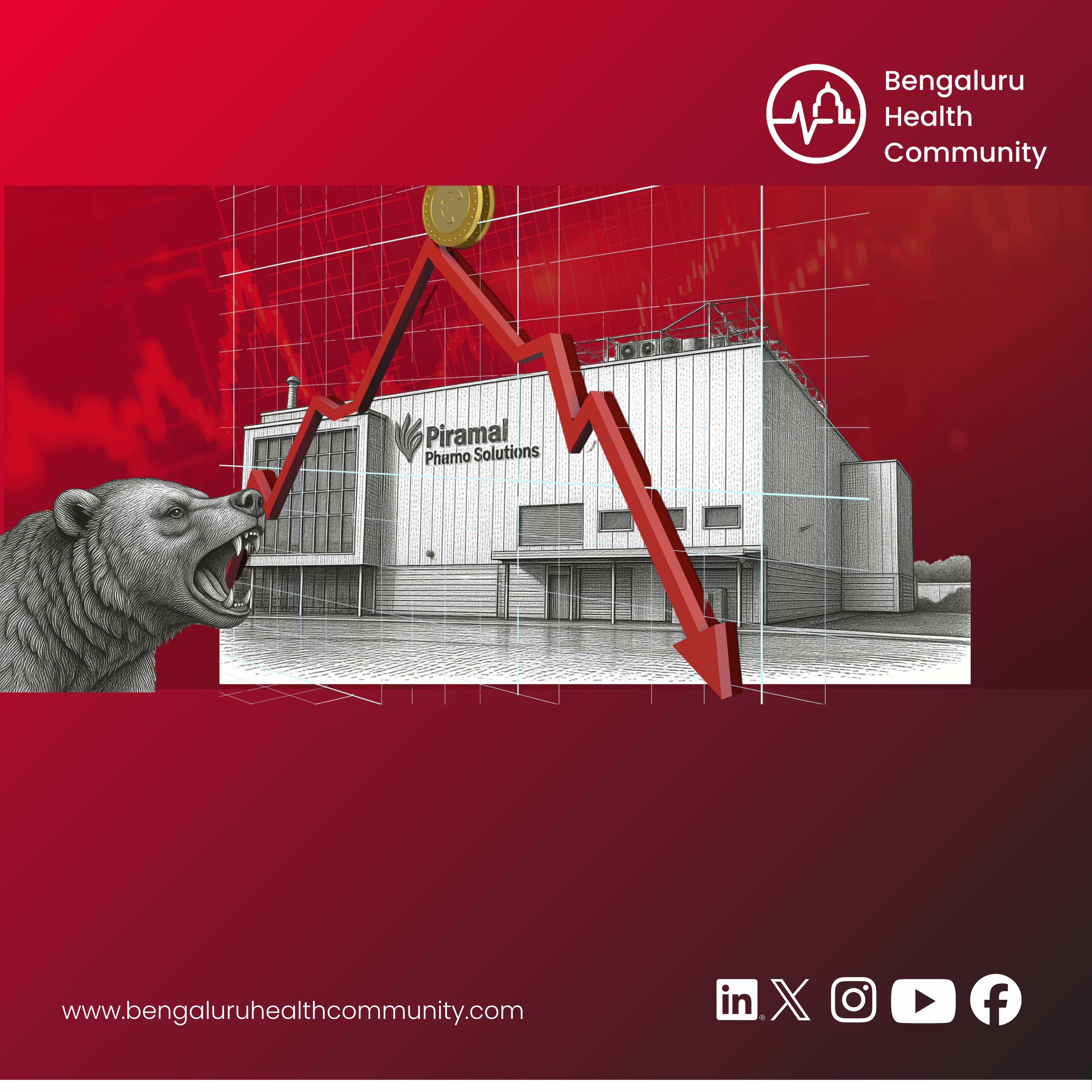
The headline financials reflect the challenge: consolidated revenue from operations reached ₹8,869 crore, a decline of 3.08% year-on-year from FY25's ₹9,151 crore. EBITDA contracted sharply to ₹1,134.92 crore (down 28.15% from FY25), and the company recorded a net loss of ₹325.94 crore, compared with a net profit of ₹91.13 crore in the prior year. Basic and diluted EPS from continuing operations fell to ₹(2.46) per share from ₹0.69 per share in FY25.
What Caused the Financial Decline
The primary driver of FY26's financial underperformance was singular and specific: inventory destocking by a key customer in the Piramal Pharma Solutions (CDMO) division, which contributed approximately 55% of PPL's consolidated revenue. The destocking involved a large on-patent commercial product — meaning a high-volume, branded pharmaceutical product that Piramal had been manufacturing under a commercial supply agreement. When the customer's inventory position required them to reduce purchases, Piramal absorbed the volume shortfall directly as a revenue gap that no other product could immediately replace at equivalent scale.
Secondary factors compounded the challenge: softer-than-expected traction in inhalation anaesthesia markets outside the United States, where Piramal Critical Care (which retains the No. 1 US Sevoflurane market position) faces intensity of competition in non-US markets. The combined effect of CDMO destocking and ex-US CHG softness, alongside ₹176 crore of impairment losses on intangible assets under development and higher depreciation from capacity additions, drove the net loss.
The Quality Record That Stands Against the Financial Narrative
While the financial results tell a challenging story, Piramal Pharma's FY2026 operational and quality performance tells a different one. The company completed 38 regulatory inspections during the year — including three US FDA inspections — without receiving a single Official Action Indicated observation. This zero-OAI status across all USFDA inspections represents one of the strongest regulatory quality track records in the Indian CDMO sector.
The company also underwent 209 customer site audits during FY26 — the highest in its history for a single year — across its global network, without any critical observations. In a sector where FDA observations, import alerts, and warning letters can devastate a CDMO's commercial pipeline, Piramal's consistent zero-OAI record is a direct commercial asset: it gives prospective customers confidence that Piramal's manufacturing infrastructure can pass the regulatory scrutiny that global pharmaceutical sponsors require.
Capital expenditure for FY26 stood at ₹890 crore, including continued investment in manufacturing capacity and capabilities. The company committed to a $90 million expansion of sterile injectable and payload-linker capacities at its Lexington, Kentucky and Riverview, Michigan facilities — investments specifically targeting the high-value ADC (antibody-drug conjugate) and sterile injectable markets where Piramal has competitive differentiation.
The FY27 Recovery Thesis
The most important forward-looking signal in PPL's Annual Report is the RFP (Request for Proposal) momentum that Nandini Piramal has consistently highlighted since the second half of FY26. RFPs represent the leading indicator of CDMO revenue: prospective customers submit RFPs to assess manufacturing capability and pricing before committing to development and supply agreements. The pickup in RFPs since late 2025, combined with improved US biopharma funding (which directly drives demand for CDMO services from biotech companies that don't have their own manufacturing), creates the commercial pipeline from which FY27 revenue will be drawn.
Management has guided for early-to-mid-teen revenue growth in FY27, with EBITDA and PAT expected to grow faster than revenue as operating leverage improves from the fixed-cost base that was underutilised during FY26's destocking period. The Kenalog acquisition (completed during FY26) is expected to be a CHG growth contributor alongside the ex-US inhalation anaesthesia market recovery.
BHC Perspective
At Bengaluru Health Community, Piramal Pharma's FY2026 story is a CDMO sector case study in how a single large-customer destocking event can compress an otherwise well-managed company's financial results — and how the right response is maintaining quality leadership and investing in capability for the next cycle. For BHC founders building in CDMO services, pharmaceutical process technology, or drug manufacturing — Piramal's zero-OAI quality record amid financial adversity is the operational benchmark that separates durable CDMO franchises from commodity contract manufacturers.
Frequently Asked Questions
Q: What were Piramal Pharma's FY2026 results?
A: Consolidated revenue from operations: ₹8,869 crore (-3.08% YoY). EBITDA: ₹1,134.92 crore (-28.15%). Net loss: ₹325.94 crore (vs. profit ₹91.13 crore in FY25). Primary cause: inventory destocking by a key CDMO customer for a large on-patent commercial product.
Q: What is Piramal's quality record?
A: 38 regulatory inspections completed in FY26, including 3 USFDA inspections — zero OAI observations across all of them. 209 customer site audits (highest ever), zero critical observations. This zero-OAI track record is a commercial asset for attracting global pharmaceutical CDMO customers.
Q: What is Piramal's FY27 outlook?
A: Early-to-mid-teen revenue growth, with EBITDA and PAT growing faster than revenue due to operating leverage. Driven by RFP recovery (improving since late 2025), US biopharma funding recovery, Kenalog acquisition contribution, and $90M sterile injectables and ADC capacity expansion at US facilities.