AI in Healthcare
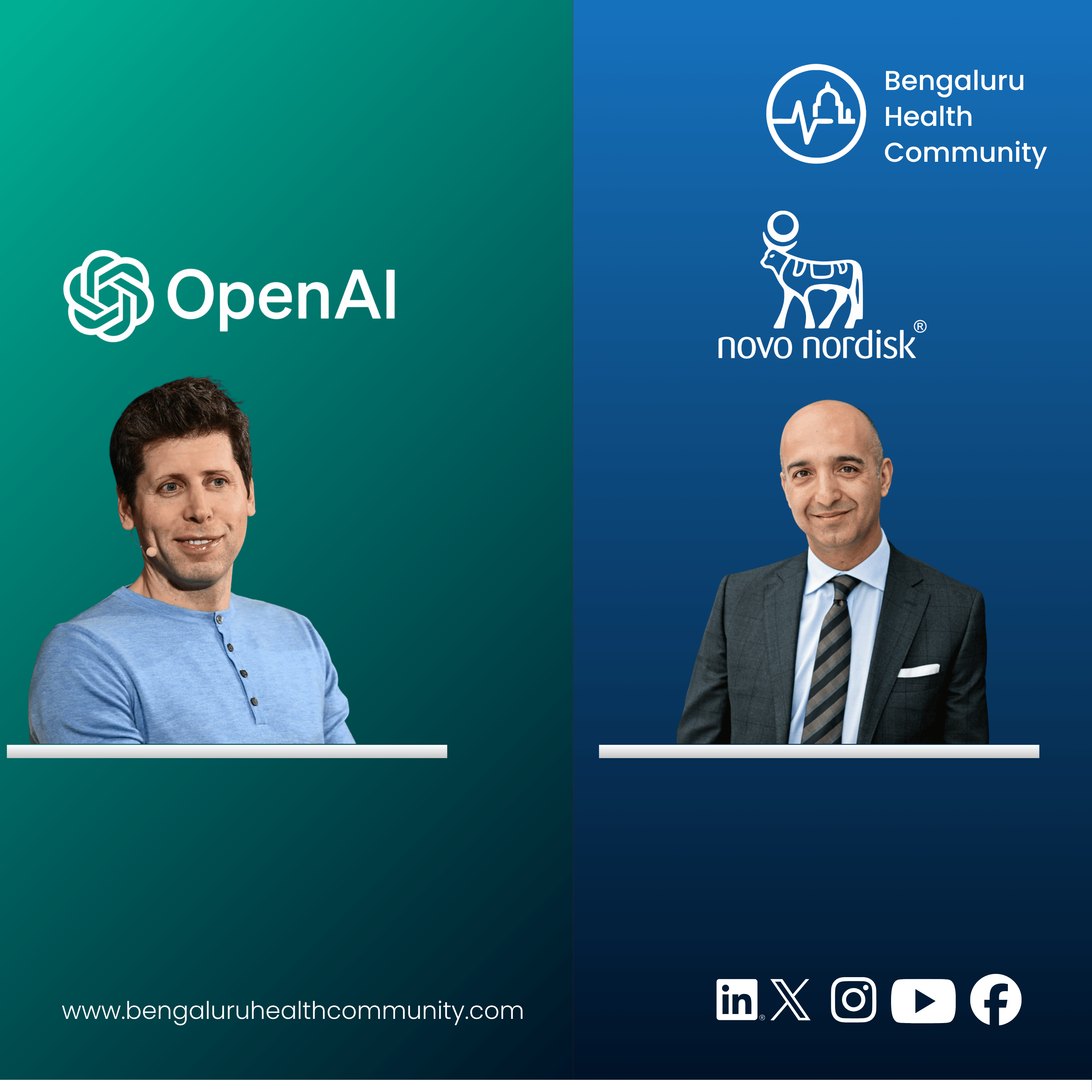
Novo Nordisk Just Partnered With OpenAI to Discover the Next Generation of Obesity and Diabetes Drugs — AI Is Now the Core of Global Pharma R&D
By Mustafa Shariff, Editor in Chief · April 16, 2026 · 5 min read
Summary
- Novo Nordisk + OpenAI: The Landmark Partnership That Signals AI Has Fully Arrived in Global Pharma R&D
- Novo Nordisk has announced a strategic partnership with OpenAI to deploy AI across drug discovery, clinical development, and manufacturing. Here is what this means for global pharma and specifically for India.
The announcement that Novo Nordisk — the world's most valuable pharmaceutical company by market capitalisation, whose GLP-1 drugs Ozempic and Wegovy triggered a global obesity treatment revolution — has partnered with OpenAI to deploy advanced AI across its entire operations is a landmark signal for the global pharmaceutical industry. It confirms what has been building quietly across the industry: AI is no longer a peripheral research tool or a pilot programme. It is becoming the core infrastructure of pharmaceutical R&D.
The collaboration is designed to deploy OpenAI's capabilities from early-stage drug discovery through to commercial supply chains. Novo Nordisk's CEO Mike Doustdar, who took over in 2025, has described the partnership as an 'essential step' in the company's transformation strategy. The focus for the initial phase is AI-accelerated discovery of next-generation therapies for obesity and diabetes — building on the commercial success of Ozempic and Wegovy while simultaneously compressing the timeline between laboratory discovery and patient access.
What AI Is Actually Doing in Drug Discovery
The practical application of AI in pharmaceutical R&D has moved well beyond the theoretical. The specific capabilities that partnerships like Novo-OpenAI are deploying include pattern recognition for identifying rare genetic markers relevant to specific disease pathways — tasks that would require hundreds of research scientists working for years can be executed by AI models in hours. Molecule screening — virtually testing millions of potential drug compounds in a simulated environment before any physical laboratory work — dramatically reduces the cost and time of early-stage discovery. And clinical simulation — using AI to model how patient populations with different genetic profiles, demographics, and comorbidities are likely to respond to candidate molecules — improves the quality of Phase I and Phase II trial design.
Novo Nordisk is also integrating AI with its NVIDIA Gefion supercomputer, creating what the company describes as a 'double-engine' AI strategy. The projected impact: the time taken to move from research to clinical application could be reduced by as much as 40%. For a disease category like obesity, where the commercial and clinical stakes are enormous and the competitive race among Lilly, Novo, Roche, and others is at its most intense, a 40% reduction in development timelines represents a decisive competitive advantage.
OpenAI's Pharma Strategy
The Novo Nordisk partnership follows OpenAI's earlier deals with Moderna and Sanofi — establishing a pattern of OpenAI positioning itself as what Sam Altman describes as the 'operating system' for the biotech boom. These partnerships give OpenAI access to proprietary biological and clinical data at a scale that no other AI company has, while giving its pharmaceutical partners AI capabilities that their own internal R&D organisations cannot replicate at speed.
Altman's framing is direct: AI can help people live longer, better lives by accelerating scientific breakthroughs that once took decades. This is not a product pitch — it is a civilisational argument for the value of the collaboration that is proving effective at attracting major pharmaceutical partners.
What This Means for Indian Pharma
For India's pharmaceutical industry, the Novo-OpenAI partnership creates two interconnected implications. The first is competitive: Indian generic manufacturers who rely on off-patent drug supply chains need to understand that the pace of drug innovation is accelerating, which means the window between originator patent and generic entry will be reached faster for new molecules. Clinical trial capabilities — specifically India's ability to run trials for novel molecules at scale and speed — become more commercially important as global pharma partners seek trial infrastructure for more rapidly developed candidates.
The second is strategic: Indian pharma companies with innovation ambitions — Sun Pharma, Dr Reddy's, Cipla, Lupin — should be watching the Novo-OpenAI model for how AI-pharma partnerships are being structured globally. India's AI talent pool, biodata assets (Ayushman Bharat Digital Mission is digitising 500 million patient records), and cost-competitive clinical research infrastructure are potentially very attractive for AI-enabled drug discovery partnerships. The country is in a window where it can position as an AI-for-healthcare destination rather than simply a manufacturing destination.
BHC Perspective
At Bengaluru Health Community, the Novo-OpenAI deal closes a loop on a narrative that has been building all year: AI is the defining force in healthcare's next decade, and the countries, companies, and clinical institutions that integrate it earliest will capture disproportionate value. Bengaluru is home to both deep AI capability (Infosys, Wipro, Google DeepMind India, a growing AI startup ecosystem) and deep healthcare capability (Biocon, Syngene, Manipal, Narayana). The intersection of those two clusters is where India's version of the Novo-OpenAI story gets written.
Frequently Asked Questions
Q: What is the Novo Nordisk-OpenAI partnership?
A: Novo Nordisk announced a strategic partnership with OpenAI to deploy advanced AI across its entire operations — from drug discovery to supply chains — with a focus on accelerating discovery of next-generation obesity and diabetes therapies.
Q: How much could AI reduce pharmaceutical development timelines?
A: According to Novo Nordisk, AI integration could reduce the time to move from research to clinical application by as much as 40% through AI-assisted molecule screening, genetic pattern recognition, and clinical simulation.
Q: What does this mean for Indian pharma?
A: Indian companies should monitor how AI-pharma partnerships are structured globally and position India's AI talent pool, digitised patient records (Ayushman Bharat Digital Mission — 500M records), and clinical research infrastructure as assets for AI-enabled drug discovery partnerships with global pharma companies.