Funding News
WHOOP Raises $575M at $10.1 Billion Valuation — And the Investors Include Abbott, Mayo Clinic, Cristiano Ronaldo, and LeBron James
By BHC, Editor in Chief · April 03, 2026 · 5 min read
Summary
- WHOOP has closed a $575 million Series G with Abbott, Mayo Clinic, and global sovereign wealth funds as investors, valuing it at $10.1 billion. Here is why this global deal matters for Indian healthcare founders and digital health investors.
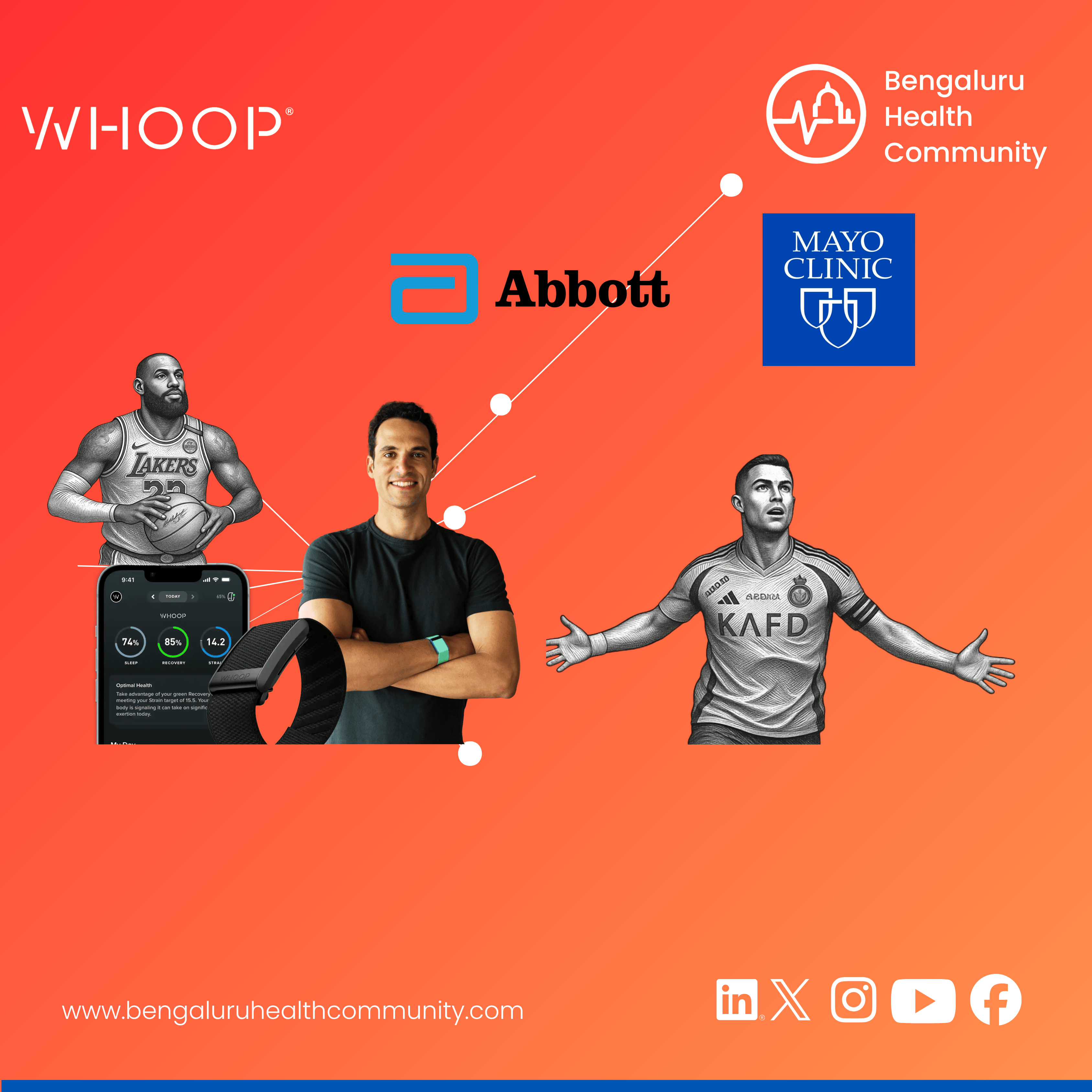
On March 31, 2026, WHOOP — the Boston-based wearable health company founded in 2012 — announced one of the largest private funding rounds ever seen in the digital health sector. The company raised $575 million in a Series G led by Collaborative Fund, with participation from a roster of investors that reads like a who's-who of global healthcare and finance: Abbott Laboratories joining as a strategic investor, Mayo Clinic, the Qatar Investment Authority, Mubadala Investment Company, and Macquarie Capital — alongside individual investors Cristiano Ronaldo, LeBron James, and Rory McIlroy. The round values WHOOP at $10.1 billion — nearly triple its previous valuation of $3.6 billion from 2021.
"Our raise brings together the world's most sophisticated investors, leading health institutions, and iconic global athletes behind the mission to unlock human performance and healthspan."
For Indian healthcare founders and digital health investors, this is not just a global funding story. It is a signal about where the health monitoring market is heading, what investors are prepared to bet at scale, and what clinical-grade wearable technology looks like when it reaches a tipping point.
**What WHOOP Actually Does
WHOOP is a subscription-based wearable device that monitors physiological data around the clock. Its wrist-worn band delivers a 14-day battery life and tracks sleep quality, recovery, strain, heart rate variability, and respiratory rate — generating personalised daily health recommendations based on the data. The platform now includes an FDA-cleared ECG, blood pressure insights, a Healthspan longevity feature, and Advanced Labs blood biomarker integration.
The numbers behind WHOOP's engagement are striking: members open the app an average of over eight times per day — nearly three times more than users of other screenless wearables. Daily WHOOP users log more than 90 additional minutes of exercise per week, get over two extra hours of sleep, and show 10% higher heart rate variability compared to non-users, according to the company's research. These are not vanity metrics — they are clinical behaviour change outcomes delivered through consumer technology.
**Why Abbott's Investment Is the Most Important Signal
Of all the investors in this round, Abbott's participation deserves the most attention. Abbott is not a fitness brand or a venture fund — it is one of the world's leading medical device and diagnostics companies, with deep expertise in continuous glucose monitoring through its FreeStyle Libre platform. When Abbott invests strategically in WHOOP, it is signalling something specific: the convergence of consumer wearable health monitoring with clinical-grade diagnostics is no longer theoretical. It is a commercial strategy.
This mirrors Dexcom's 2024 investment in Oura — where the leading CGM company took a stake in the health-tracking ring maker. The pattern is clear: established medical device players are acquiring strategic positions in consumer health monitoring platforms, anticipating a future where continuous physiological monitoring data integrates directly with clinical care pathways.
**The FDA Reversal That Changed Everything
WHOOP's journey to this valuation was not smooth. In July 2025, the FDA issued a warning letter specifically targeting WHOOP's Blood Pressure Insights feature, classifying it as a medical device requiring a 510(k) clearance — a regulatory pathway that would have significantly slowed WHOOP's ability to offer the feature. In January 2026, the FDA reversed that position, ruling that WHOOP's blood pressure monitoring falls under general wellness exemptions rather than requiring full medical device clearance.
That reversal was a turning point. It validated WHOOP's approach to clinical-adjacent health monitoring and removed a major regulatory overhang. The $575 million raise followed three months later. The timing is not coincidental.
**India's Implications
WHOOP plans to accelerate international expansion across Europe, the Gulf states, Latin America, and Asia. The company currently ships to 56 countries and sees major growth opportunities in new markets. India — with its 300 million smartphone users, rapidly growing preventive health awareness, and a young, fitness-conscious middle class — is a natural target market.
More broadly, the WHOOP round validates the wearable health monitoring category as a serious investment thesis at scale. For Indian founders building in continuous health monitoring, preventive diagnostics, or health data analytics — the global capital environment has never been more favourable. The challenge for Indian companies is not the market opportunity. It is building the clinical validation, data infrastructure, and regulatory relationships that attract the kind of strategic investors Abbott represents.
**BHC Perspective
At Bengaluru Health Community, we see the WHOOP Series G as a defining moment for the wearable and preventive health sector globally. The integration of elite athletic performance culture with clinical health monitoring — with Abbott and Mayo Clinic validating the platform — represents a category graduation. Consumer health wearables are no longer fitness gadgets. They are becoming clinical infrastructure. Indian founders building in this space should be studying WHOOP's product strategy, data model, and regulatory navigation as a blueprint for what the category can become.
**Frequently Asked Questions
Q: What is WHOOP and what does it do?
A: WHOOP is a subscription-based wearable health company that provides 24/7 physiological monitoring across sleep, recovery, strain, and longevity. Its platform includes an FDA-cleared ECG, blood pressure insights, and AI-powered health recommendations.
Q: Why did Abbott invest in WHOOP?
A: Abbott invested strategically in WHOOP as part of a broader trend of medical device and diagnostics companies acquiring positions in consumer health monitoring platforms, anticipating the convergence of wearable data with clinical diagnostics.
Q: What is WHOOP's valuation after the Series G?
A: Following the $575 million Series G led by Collaborative Fund, WHOOP is valued at $10.1 billion — nearly triple its previous valuation of $3.6 billion from 2021.