News
JIPMER Has Capped Resident Doctor Duty Hours at 12 Per Stretch — And the Grant Thornton Q1 2026 Pharma Dealtracker Shows $1.9 Billion Keeps Flowing Into Indian Healthcare
By Mustafa Shariff, Editor in Chief · May 06, 2026 · 5 min read
Summary
- JIPMER's 12-Hour Duty Cap and India's Q1 2026 Healthcare Deal Landscape: Two Signals From the Same Industry Week
- JIPMER has formally implemented a 12-hour duty cap for resident doctors. Grant Thornton Bharat's Q1 2026 Pharma Dealtracker shows $1.9 billion in healthcare deals. Here is the full analysis.
"The Residency Scheme clearly limits resident doctors' duty hours to a maximum of 12 hours per day and 48 hours per week. This is not new guidance — it is existing guidance that has been violated. JIPMER is now enforcing it. Every teaching hospital in India should follow."
JIPMER's 12-Hour Duty Cap
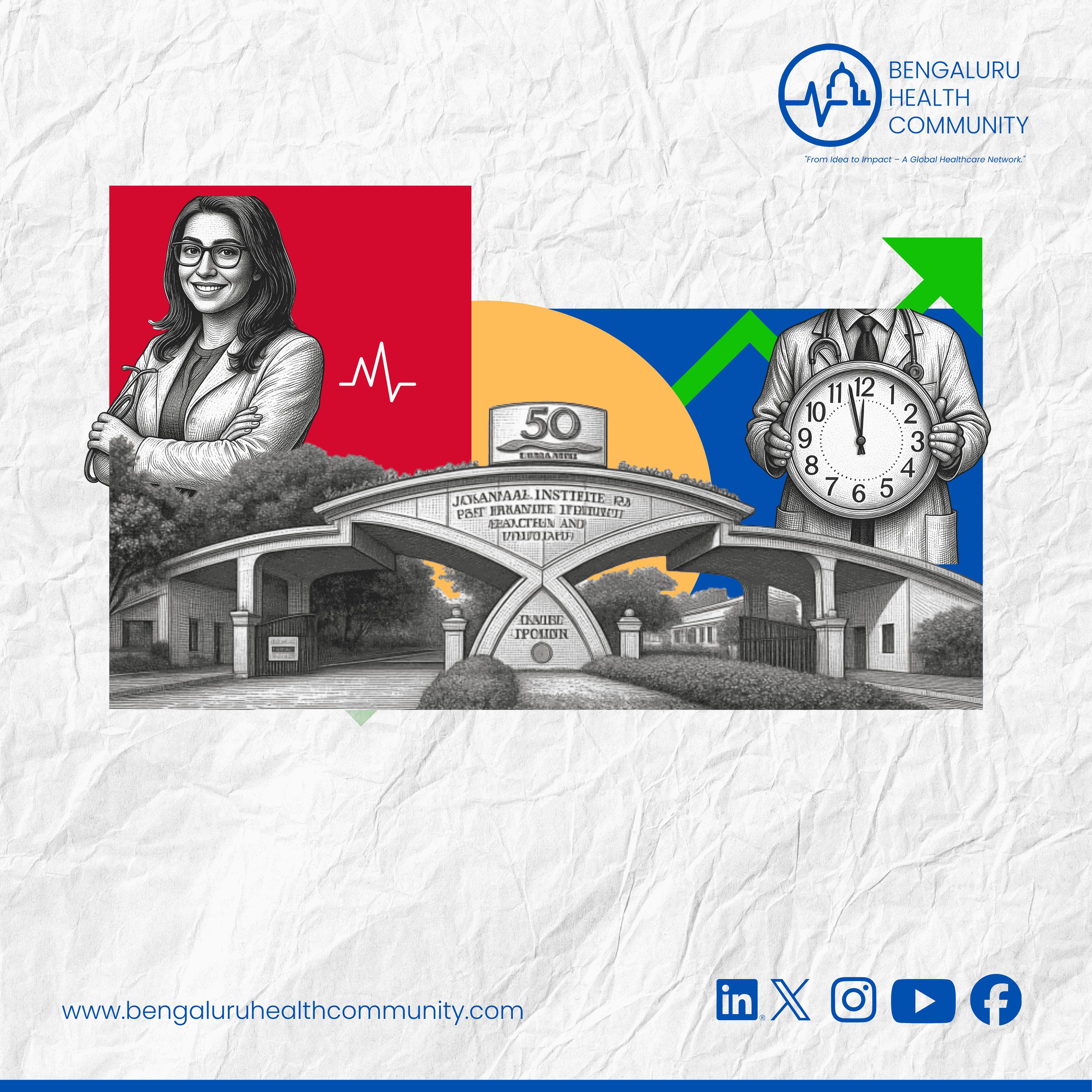
The Jawaharlal Institute of Postgraduate Medical Education and Research — JIPMER — one of India's premiere medical institutions located in Puducherry, with the status of an Institute of National Importance — issued a formal circular on April 28, 2026, implementing the Ministry of Health and Family Welfare's Residency Scheme framework and formally capping resident doctor duty hours at 12 hours per stretch and 48 hours per week maximum.
The circular references the Residency Scheme implemented by the Ministry of Health on June 5, 1992 — following directions from the Supreme Court — which has nominally set these duty hour limits for over three decades. The significance of JIPMER's circular is not the creation of new standards but the formal institutional enforcement of standards that have been in place since 1992 but routinely violated across India's teaching hospitals. JIPMER doctors welcomed the move.
BHC Media covered the resident doctor duty hours crisis in our April 17 edition — documenting how Indian teaching hospital residents routinely work shifts extending 24 hours or more, how sleep deprivation at this magnitude is clinically equivalent to alcohol intoxication in its effect on decision-making, and why this is fundamentally a patient safety problem rather than simply a workforce welfare issue. JIPMER's enforcement action is the institutional response that the April 17 editorial called for.
The broader question is whether other major teaching hospitals — AIIMS Delhi, AIIMS Bengaluru, all the state government medical college hospital systems — will follow JIPMER's lead. The 12-hour/48-hour standard is not unreasonable or difficult to implement if hospital administrations also staff the non-resident clinical roles that currently run on resident labour. The staffing model is the structural challenge. The will to enforce is the institutional challenge. JIPMER has demonstrated both.
Grant Thornton Q1 2026 Healthcare Dealtracker
Grant Thornton Bharat's Q1 2026 Pharma and Healthcare Dealtracker presents the deal landscape that both validates investor confidence and reveals where capital is flowing. Total deals: 78 transactions worth approximately $1.9 billion in Q1 2026. The headline number is down from Q1 2025's $2.6 billion — but that comparison is misleading without accounting for deal composition.
M&A activity recorded 30 deals worth $915 million — down 40% quarter-on-quarter due to the absence of high-value large-ticket transactions in Q1 2026. The prior quarter's numbers were inflated by several large strategic acquisitions (KKR-BMH-Star, Indira IVF-Abha, etc.) that naturally compress the sequential comparison. Domestic consolidation continued through smaller transactions under $50 million in hospitals and pharma/biotech.
The most strategically interesting data point in the dealtracker is the PE/VC segment: 45 deals worth $456 million, with volume up 22% year-on-year but value relatively flat. The volume increase — more deals, at smaller average size — reflects the current investment thesis playing out in India's healthtech venture market. The dominant themes in PE/VC deal activity: early-stage healthtech, wellness, AI diagnostics, and preventive care. This is the exact investment category that BHC's mentorship platform, HMEP cohort, and media ecosystem is designed to serve.
The quarter's standout deal was ChrysCapital's $157 million acquisition of a 71% stake in Novartis India Limited — a strategic move by one of India's most experienced healthcare PE firms to acquire a profitable domestic branded pharmaceutical business at an attractive valuation. And in the outbound segment, Infosys's $465 million acquisition of Optimum Healthcare IT — a US-based healthcare digital transformation firm — demonstrated that Indian companies are increasingly acquiring international healthcare IT assets to build global services platforms.
The Policy Week in Context
The JIPMER duty cap and the Grant Thornton dealtracker, placed alongside this week's other healthcare stories — NBCS 2026 hospital height reform, Dr Reddy's Health Canada semaglutide approval, Aurigene's $100 million CRDMO investment — describe a healthcare ecosystem in active, consequential transition. Infrastructure policy is being reformed. Clinical workforce standards are being enforced. Drug manufacturing capability is being built. Capital is flowing at scale into early-stage innovation. And the commercial proof points — generic Ozempic approved in Canada, India's first integrated gynae-oncology robotic ecosystem — are arriving.
BHC Perspective
At Bengaluru Health Community, the JIPMER duty cap is a story about institutional leadership doing the right thing, and the dealtracker data is the financial confirmation that the healthcare innovation thesis is being validated by real capital at scale. Both stories reinforce BHC's purpose: building the mentorship, education, and community infrastructure that supports India's healthcare professionals and founders as they navigate this transformation.
Frequently Asked Questions
Q: What did JIPMER announce regarding resident doctors?
A: On April 28, 2026, JIPMER issued a formal circular implementing the Ministry of Health's 1992 Residency Scheme — formally capping resident doctor duty hours at 12 hours maximum per stretch and 48 hours per week. JIPMER doctors welcomed the enforcement of what has been nominal policy for over 30 years.
Q: What does Grant Thornton's Q1 2026 Pharma Dealtracker show?
A: 78 deals worth $1.9 billion in Q1 2026 across India's pharma and healthcare sector. PE/VC volume up 22% year-on-year, focused on early-stage healthtech, AI diagnostics, wellness, and preventive care. ChrysCapital's $157 million Novartis India stake was the quarter's top PE deal.
Q: What does the surge in early-stage healthtech investment signal?
A: The 22% increase in PE/VC deal volume — concentrated in early-stage healthtech, AI diagnostics, and preventive care — confirms that institutional investors are backing exactly the innovation categories that India's healthcare transformation requires: technology that extends clinical capability, improves detection, and reduces the reactive disease burden.