News
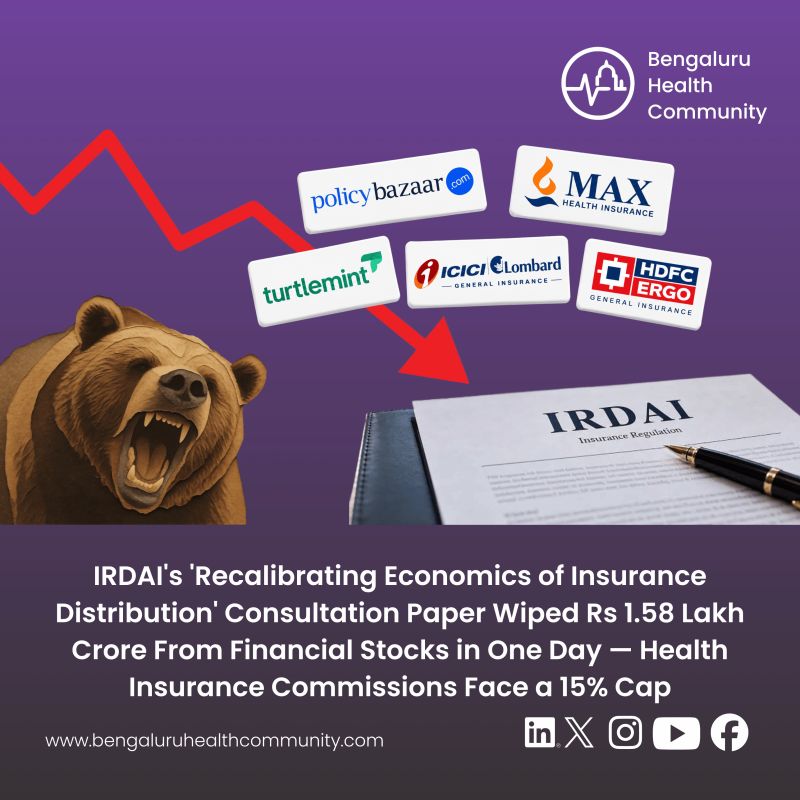
IRDAI's 'Recalibrating Economics of Insurance Distribution' Consultation Paper Wiped Rs 1.58 Lakh Crore From Financial Stocks in One Day — Health Insurance Commissions Face a 15% Cap
By Mustafa Shariff, Editor in Chief · September 28, 2026 · 2 mins read
Summary
- IRDAI's Insurance Distribution Overhaul Crashes PB Fintech 36%, Wipes Rs 1.58 Lakh Crore — Health Insurance Commission Caps Proposed at 15%
- IRDAI's 'Recalibrating Economics of Insurance Distribution' consultation paper (September 23, 2026) sent PB Fintech down 36% (Rs 31,000 crore wiped) and crashed the financial sector by Rs 1.58 lakh crore — proposing 15% health insurance first-sale commission and 5% renewal caps.
"These reforms will separate insurtech models built on commissions from those built on customer value. The proposed market infrastructure institutions, with Bima Sugam as one of them, together with standardised product infrastructure, are designed to fundamentally restructure how insurance is distributed in India. The companies that survive this transition will be those that have invested in customer relationships and product capabilities, not just distribution margins. The companies built purely on commission arbitrage have a very difficult road ahead."
IRDAI released its consultation paper titled 'Recalibrating Economics of Insurance Distribution' on the evening of September 23, 2026. By the close of trading on September 24, it had produced one of the most severe single-sector market reactions in India's recent financial market history: PB Fintech, the parent company of Policybazaar and Paisabazaar, had lost 36% of its market value — its worst single-day drop since listing — erasing approximately Rs 31,000 crore in market capitalisation in a matter of hours.
What IRDAI Is Proposing
The consultation paper proposes a structural overhaul of insurance distribution economics across all insurance segments. For health insurance — most directly relevant to BHC Media's community — IRDAI proposes capping distributor commissions at 15% of first-year premiums on new sales and 5% on renewals. For motor insurance, the proposals are more severe: nil commission on new-vehicle third-party insurance and a 5% cap on own-damage cover. For life insurers, the expense-of-management ceiling is to be reduced to 15% of gross direct premium income within two years and 12.5% within five years.
Beyond the commission and expense changes, the paper proposes three structural reforms: banning dark patterns — design tactics on insurance checkout pages that push consumers toward specific products or force data sharing; prohibiting mandatory insurance bundling with bank loans; and establishing a clearer commission structure based on segment, line of business, distribution channel, and product complexity rather than a single universal rate.
The Market Reaction: Why It Was This Severe
The severity of the market reaction — Rs 1.58 lakh crore in total financial sector market cap loss — reflects the earnings sensitivity of India's insurance distribution sector to commission rates. PB Fintech's business model is fundamentally built on the commission spread between insurers and policyholders. Macquarie analysts noted after the crash that PB Fintech appears to be 'the most exposed to the proposed changes because of its earnings sensitivity to take rates.' With a 15% first-year cap and 5% renewal cap on health insurance, the commission economics of digital insurance aggregation change materially.
Jefferies analysts took a more nuanced view, seeing the correction as a buying opportunity for insurers with limited exposure: SBI Life, Star Health, and ICICI Lombard were highlighted as insurers relatively insulated from the proposed changes, with potential for market-share gains and margin expansion if the reforms proceed.
The Timeline and What Happens Next
IRDAI has invited stakeholder feedback on the consultation paper until October 25, 2026. Implementation is proposed from financial year 2027-28 (beginning April 2027). Importantly, the proposals are not yet final regulation — they are a consultation paper, and the feedback process typically results in modifications. However, Jefferies analysts noted that IRDAI published supporting data alongside the paper, suggesting the regulator has a strong evidence base for the proposals and limiting the probability of a major rollback.
BHC Perspective
At Bengaluru Health Community, IRDAI's insurance distribution overhaul is the most consequential India health insurance regulatory event of 2026. For BHC's insurance-tech founders and health insurance community: the proposals are designed to shift value from distribution margin to customer value. The models that survive this transition — and potentially thrive — are those built on genuine health insurance product expertise, customer relationship depth, and technology-enabled service delivery rather than commission arbitrage. The BHC community's focus on healthcare value creation positions it well for the post-reform insurance distribution landscape.
FAQs
Q: What did IRDAI propose on September 23?
A: A sweeping overhaul of insurance distribution economics — 'Recalibrating Economics of Insurance Distribution' consultation paper. Key proposals: health insurance commissions capped at 15% (first sale) / 5% (renewals); nil commission on new-vehicle third-party motor insurance; life insurer expense-of-management ceiling reduced to 12.5% in 5 years; ban on dark patterns and mandatory loan-bundled insurance.
Q: What was the market reaction?
A: September 24: PB Fintech (Policybazaar parent) crashed 36% — worst single-day drop since listing — Rs 31,000 crore market cap wiped. Turtlemint: 20% lower circuit. Max Financial: -9.8%. HDFC Life: -6.2%. ICICI Prudential: -4.2%. Total financial sector: Rs 1.58 lakh crore market cap loss.
Q: Are these proposals final?
A: No. IRDAI has invited stakeholder feedback until October 25, 2026. Implementation proposed from FY28 (April 2027). Jefferies notes IRDAI published supporting data alongside the paper — limiting probability of major rollback but not ruling out modifications.