News
India Reads the Most Radiology Studies of Any Country in the World — And AI-Enabled Adjudication Is Now Coming to Ayushman Bharat's Claims System
By Mustafa Shariff, Editor in Chief · May 15, 2026 · 2 min read
Summary
- India: The World's Largest Radiology Market Meets AI-Enabled Ayushman Bharat Adjudication
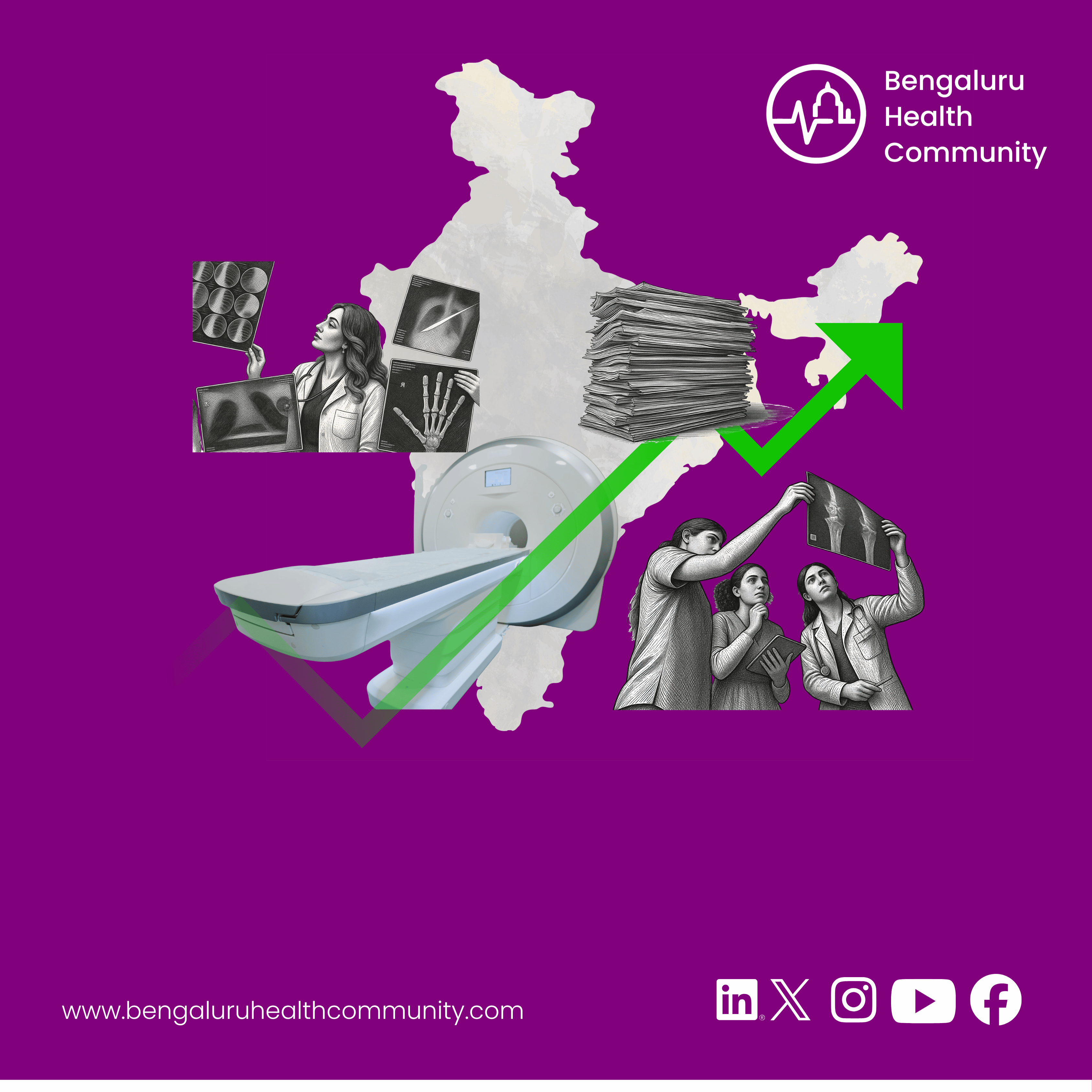
- India reads more radiology studies than any other country. The NHA is deploying AI for Ayushman Bharat claims adjudication. Here is why these two facts together define India's most significant AI healthcare opportunity.
"AI-enabled adjudication will enhance efficiency and programme integrity under AB PM-JAY. Robust, responsible AI integration into public health insurance operations is essential for a scheme of this scale to function with the accuracy and speed that 50 crore beneficiaries deserve."
Two developments this week, arriving separately, tell a single coherent story about where India's healthcare AI opportunity is most concentrated and most commercially actionable.
The first is a data point that has significant implications for the AI diagnostics sector: India reads more radiology studies annually than any other country. This is not a marginal distinction — it reflects the combination of India's 1.4 billion population, its rapidly expanding hospital imaging infrastructure, the growing availability of CT and MRI scanning at mid-tier hospitals, and the structure of India's teleradiology market, which has built one of the world's most sophisticated remote radiology reporting ecosystems. Companies like Teleradiology Solutions (founded in Bengaluru in 2002 and among the world's first commercial teleradiology companies), Qure.ai, DeepTek, and a growing field of AI radiology startups have built their commercial positions precisely because India's imaging volume creates the scale required for AI training and deployment at commercial viability.
India's Radiology Volume and What It Creates
Being the world's highest-volume radiology market creates specific structural advantages for India's healthcare AI sector. AI models for medical imaging require large training datasets to achieve clinical-grade accuracy — the more diverse and voluminous the training data, the more robust the model. India's imaging volume, combined with the diversity of pathology presentations across its 1.4 billion patient population (including high rates of tuberculosis, non-communicable diseases, tropical infections, and rare genetic conditions that are less common in Western patient populations), creates training data that is richer in clinically relevant diversity than data from smaller, more homogeneous patient populations.
This training data advantage is already being commercially exploited. Qure.ai's chest X-ray AI models, trained substantially on Indian patient data, have achieved regulatory approvals across multiple jurisdictions and are deployed in hospitals across India, Southeast Asia, Africa, and Latin America — markets where India-like patient populations and disease patterns make India-trained AI models more clinically applicable than models trained exclusively on Western data. DeepTek's collaboration with Germany's deepc (covered in BHC Media April 21) similarly leverages the radiology volume advantage to build enterprise-grade radiology AI infrastructure.
AI Adjudication Coming to Ayushman Bharat PM-JAY
The second development is a specific and operationally significant policy announcement: the National Health Authority has announced the deployment of robust AI-enabled adjudication for Ayushman Bharat Pradhan Mantri Jan Arogya Yojana. Dr Sunil Kumar Barnwal, CEO of NHA, stated that the AI-enabled adjudication system will enhance both efficiency and programme integrity under AB PM-JAY.
The context matters: AB PM-JAY processes crores of hospital claims annually across its 50-crore beneficiary base. Conventional claims adjudication — matching hospital claims against defined package rates, verifying beneficiary eligibility, cross-checking procedure coding, and detecting anomalous patterns that may indicate fraud or billing errors — requires enormous manual processing capacity when done at the scale PM-JAY operates. Manual adjudication is also slower, less consistent, and more susceptible to human judgment variation than AI-assisted processes.
AI adjudication addresses these limitations systematically. Machine learning models trained on historical PM-JAY claims data can identify legitimate claims, flag potentially problematic claims for human review, detect patterns associated with fraud or overbilling, and verify procedural coding accuracy at speeds and volumes that manual processes cannot match. The programme integrity dimension is commercially significant: the National Health Authority estimates that fraud, waste, and abuse in health insurance schemes can consume 3-5% of total claims volume. At PM-JAY's scale — which processes tens of thousands of crore rupees in claims annually — even a 1% improvement in fraud detection translates to thousands of crore rupees in programme savings.
The Connected Opportunity
Read together, these two developments define an AI healthcare opportunity that is specifically Indian and globally significant. The world's largest radiology imaging volume creates the training data for the world's most clinically robust medical imaging AI models. The world's most ambitious government health insurance scheme is deploying AI for claims management at scale. And the IndiaAI-ICMR partnership (covered as today's lead story) is building the infrastructure to combine compute resources with biomedical datasets at national scale. These are not separate stories — they are components of the same emerging reality: India is building the data, infrastructure, and deployment environment for a healthcare AI ecosystem that will be globally significant.
BHC Perspective
At Bengaluru Health Community, the combination of India's radiology volume leadership and PM-JAY's AI adjudication deployment is the most direct commercial signal yet for BHC's founders building in medical imaging AI, claims management technology, fraud analytics, or health insurance technology. The deployment environment is national scale, the data volume is global leadership, and the policy commitment to AI integration is now explicitly on record from the National Health Authority. For BHC mentors with expertise in health insurance technology, actuarial science, or medical imaging — this is the week to be in conversation with the next generation of founders building in these categories.
Frequently Asked Questions
Q: Why does India read the most radiology studies globally?
A: India's 1.4 billion population combined with rapidly expanding hospital imaging infrastructure, a well-developed teleradiology ecosystem, and growing mid-tier hospital CT and MRI access makes India the world's highest-volume medical imaging market — creating training data advantages for AI diagnostics companies.
Q: What is NHA's AI-enabled adjudication for PM-JAY?
A: The National Health Authority is deploying AI to automate claims processing, verify beneficiary eligibility, detect fraud and billing anomalies, and improve coding accuracy across Ayushman Bharat PM-JAY's 50-crore beneficiary base — improving both efficiency and programme integrity at scale.
Q: How do India's radiology volume and PM-JAY AI adjudication connect?
A: Together they describe the two most commercially significant AI healthcare deployment environments in India: medical imaging AI trained on world's largest patient volume, and health insurance AI deployed at the world's most ambitious government scheme. Both are enabled by the IndiaAI-ICMR compute and data infrastructure announced this week.