Funding News
IISc Spinout Venomics AI Raises $2.7 Million to Turn Snake Venom Into Drugs
By Mustafa Shariff, Editor in Chief · November 13,2026 · 2 mins read
Summary
- IISc Bengaluru Spinout Venomics AI Raises $2.7M for Venom Drug Discovery | BHC Media
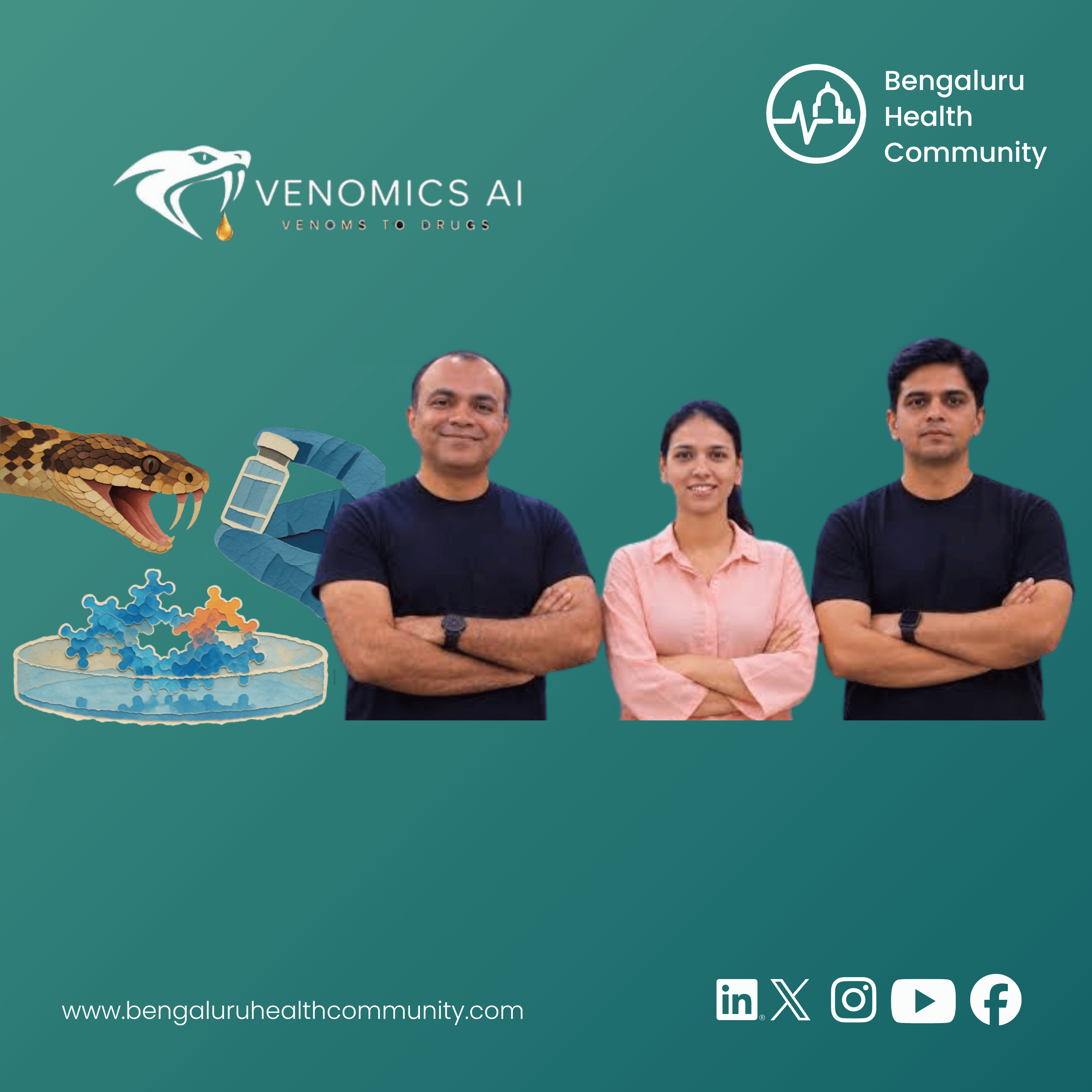
- Venomics AI, an IISc Bengaluru spinout, closes $2.7 million in seed funding to use artificial intelligence in discovering therapeutic molecules from animal venoms — starting with snakebite antivenom and expanding into cancer, cardiovascular, and neurological diseases.
"Nature's most lethal biochemical arsenals may become tomorrow's most precise medicines — Venomics AI is betting its first dollars on that thesis."
On 5 November 2026, Venomics AI — a drug discovery company that originated at the Indian Institute of Science (IISc) in Bengaluru — announced the closure of a $2.7 million (approximately ₹22.5 crore) seed funding round. The company applies AI and machine learning to characterise animal venoms, identify bioactive peptides with therapeutic potential, and develop them into drug candidates at a fraction of the cost and time of conventional discovery approaches. The seed capital will be used to expand the AI platform, establish research partnerships with hospital networks, and progress lead compounds into early preclinical programmes.
The Science: Why Venom?
Animal venoms are among the most complex and pharmacologically rich substances in nature. Snake, spider, cone snail, and scorpion venoms contain thousands of peptides and proteins that have been refined by millions of years of evolution to interact with exquisite precision with biological targets in prey. Many of these targets — ion channels, receptors, enzymes — are the same targets that pharmaceutical companies spend billions trying to modulate with synthetic drugs. Critically, nature has already optimised venom compounds for stability, selectivity, and potency. The pharmaceutical industry has long recognised this potential: captopril (the first widely used ACE inhibitor for blood pressure) was derived from pit viper venom, and exenatide (Byetta, for type 2 diabetes) originated from Gila monster venom. The challenge has always been speed — manually characterising the thousands of compounds in a single venom sample takes years. Venomics AI applies large language models and other machine learning architectures to collapse this timeline from years to weeks.
The Snakebite Crisis: India's Most Overlooked Health Emergency
Snakebite envenomation causes an estimated 81,000 to 138,000 deaths globally every year, with India accounting for the single highest national death toll — estimates range from 46,000 to over 58,000 deaths annually in India alone. This makes snakebite one of India's deadliest infectious and environmental health conditions, yet it receives a fraction of the research funding directed at diseases like malaria or tuberculosis despite comparable mortality. Existing antivenoms are horse- or sheep-derived, batch-variable in potency, poorly targeted to specific venom types, and have significant side-effect profiles. IISc researchers — who have collaboratively used Claude AI and other large language models in their antivenom research programme — have been building the foundational science to design a universal, recombinant antivenom that is safer and more broadly effective than current products. Venomics AI is the commercial vehicle to bring this science to scale and clinical development.
Beyond Snakebite: Oncology, CVD, and Neurology
The IISc research team and Venomics AI's leadership see snakebite as the initial application area but not the limit of the platform. Venom-derived compounds have shown early-stage promise in oncology (where their selective cell-killing mechanisms are of interest), cardiovascular disease (ion channel modulation), chronic pain (block of specific pain receptors), and neurological conditions (neuroprotective peptides). The seed capital will fund work across these therapeutic areas, with the goal of building a pipeline of three to five preclinical-stage candidates across multiple disease categories within two to three years.
Bengaluru's Biotech Moment
Venomics AI is part of a growing wave of IISc spinouts commercialising deep-science platforms developed in the university's research programmes. It joins a cohort of Bengaluru-based biotech companies — including Aganitha, Bugworks, and Pandorum Technologies — that are building globally relevant biology and AI platforms from India. The seed round validates investor appetite for this category and reinforces Bengaluru's emerging position as a hub not just for software and digital health, but for deep life science and therapeutic innovation.
BHC Perspective
The story of Venomics AI is exactly the kind of innovation narrative the Bengaluru Health Community was built to support and amplify. India loses tens of thousands of people every year to a preventable condition — snakebite — while the scientific tools to address it are being developed at an institution in this very city. Venomics AI is not just a startup raising money; it is a proof point that world-class science, homegrown talent, and AI can combine to address health problems that the global pharmaceutical industry has historically underserved. BHC encourages its network — founders, clinicians, investors, and hospital leaders — to follow this company closely as a case study in impact-driven biotech.
Frequently Asked Questions
Q: What is Venomics AI and what does its platform do?
A: Venomics AI is a drug discovery company spun out of IISc Bengaluru that uses AI and machine learning to characterise animal venoms, identify bioactive peptides with therapeutic potential, and develop them into drug candidates. Its platform can process venom sample data at a scale and speed that conventional biochemical analysis cannot match, dramatically accelerating the identification of compounds with pharmaceutical value. It was seeded from IISc's snakebite antivenom research programme.
Q: Why is India particularly important for snakebite research?
A: India accounts for the highest single-country annual death toll from snakebite in the world — estimates range from 46,000 to over 58,000 deaths per year. Despite this, snakebite receives a fraction of the research investment directed at diseases with comparable mortality. India also has enormous biodiversity in its snake populations, making the development of broad-spectrum or universal antivenoms both scientifically challenging and critically necessary. As an IISc spinout, Venomics AI has direct access to India's snakebite epidemiological context, clinical partners, and venom sample collection networks.
Q: What other diseases beyond snakebite could venom-derived drugs treat?
A: Venom compounds have shown early-stage promise across multiple disease categories. In oncology, certain venom peptides have selective cytotoxicity for cancer cells. In cardiovascular medicine, compounds derived from venoms have been used to develop ACE inhibitors and anti-platelet drugs. In pain management, venom-derived peptides can block specific pain-sensing ion channels. In neurology, neuroprotective compounds from venoms are being explored. Venomics AI plans to build a pipeline across several of these areas as its platform matures.
Q: How does AI speed up venom drug discovery?
A: A single snake venom contains thousands of different peptides and proteins. Conventionally, characterising even a subset of these compounds requires years of biochemical work — separating compounds, testing each one for activity, and iterating on structure to improve efficacy and reduce toxicity. AI platforms like Venomics AI's apply large language models and machine learning to predict which compounds are likely to have therapeutic activity, which structural features drive that activity, and how to optimise them — allowing the team to prioritise and fast-track only the most promising candidates, collapsing a multi-year process into weeks or months.