News
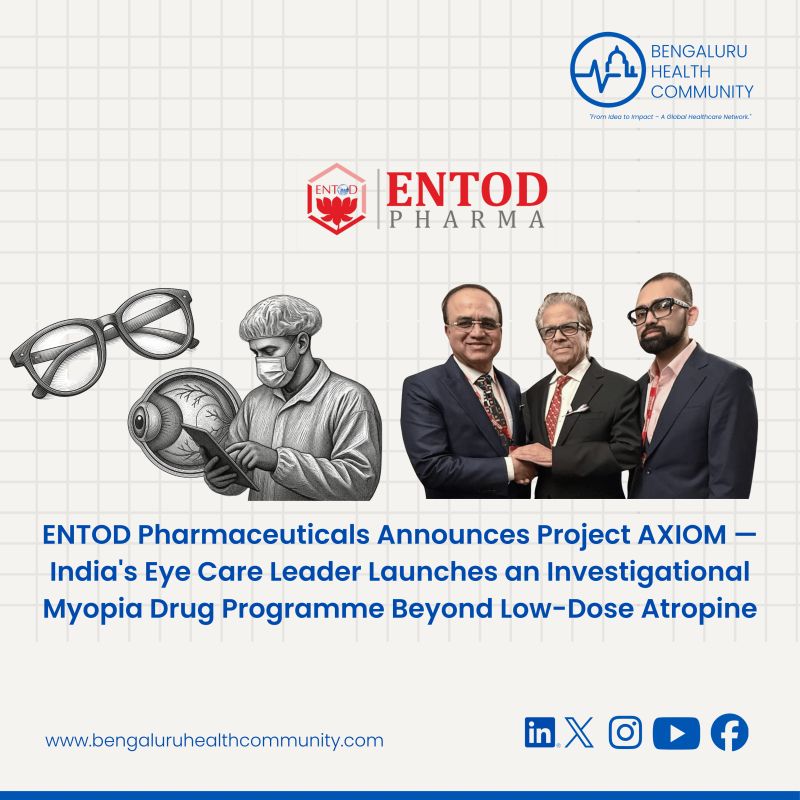
ENTOD Pharmaceuticals Announces Project AXIOM — India's Eye Care Leader Launches an Investigational Myopia Drug Programme Beyond Low-Dose Atropine
By Mustafa Shariff, Editor in Chief · September 01,2026 · 2 mins read
Summary
- ENTOD Pharmaceuticals Launches Project AXIOM: Investigational Myopia Drug AKMYX-101 Marks India's Next Chapter in Eye Care Therapeutics
- ENTOD Pharmaceuticals announced Project AXIOM on India's 80th Independence Day (August 15) — centred on AKMYX-101, an investigational topical ophthalmic candidate for myopia therapeutics beyond low-dose atropine, developed from indigenous Indian pharmaceutical research.
"Project AXIOM begins today — perhaps my biggest dream project in ophthalmology, because ultimately, it is a dream for our children, for their future vision and for India. At its heart is AKMYX-101, ENTOD's investigational topical ophthalmic candidate, as we begin exploring the future of myopia therapeutics beyond low-dose atropine therapy. Born from indigenous Indian pharmaceutical research and forward engineering, Project AXIOM represents our ambition to create new science in India that could one day make an impact globally. This could open an entirely new chapter in myopia therapeutics."
ENTOD Pharmaceuticals, India's fastest-growing top-5 ophthalmic pharmaceutical company, announced Project AXIOM on India's 80th Independence Day — August 15, 2026 — with wider reporting on August 25. The announcement, made by the company's leadership team, introduces AKMYX-101: an investigational topical ophthalmic candidate for myopia therapeutics that represents a deliberate step beyond the low-dose atropine field that ENTOD itself pioneered in India.
ENTOD's Myopia Background
ENTOD Pharmaceuticals was the first company in the world to successfully develop and commercialise an eye drop for slowing the progression of myopia in children — low-dose atropine ophthalmic solution, which has become one of the most widely used myopia control agents globally. Myopia control is a clinically significant need: childhood myopia (short-sightedness) is increasing rapidly worldwide, with global prevalence projected to reach 50% of the world population by 2050. Untreated progressive myopia increases the risk of serious sight-threatening conditions in adulthood including glaucoma, retinal detachment, macular degeneration, and cataracts.
Low-dose atropine (typically 0.01% to 0.05%) has robust clinical evidence for slowing myopia progression in children — reducing the annual rate of axial length elongation by approximately 50-70% in clinical trials. However, the mechanism of action of atropine in myopia control is not fully understood, efficacy varies across patients, and rebound progression can occur when treatment is stopped. These limitations create the scientific rationale for AKMYX-101 — an investigational candidate that explores myopia therapeutics beyond the atropine paradigm.
Project AXIOM and AKMYX-101
Project AXIOM is ENTOD's structured research programme for AKMYX-101 — described as born from indigenous Indian pharmaceutical research and forward engineering. The specific mechanism of action, molecular structure, and clinical development timeline for AKMYX-101 have not yet been publicly disclosed — consistent with the early investigational stage that the announcement describes. Nikkhil K Masurkar, Executive Director at ENTOD, noted: 'We're not revealing everything just yet. But what I can say is that this could open an entirely new chapter in myopia therapeutics.'
The Independence Day timing of the announcement is deliberate and meaningful: ENTOD is positioning AKMYX-101 as indigenous Indian pharmaceutical innovation — new science created in India with the potential for global impact. ENTOD's existing regulatory and commercial infrastructure across 67-plus countries provides the global pathway that a successful AKMYX-101 clinical development programme could utilise.
India's Myopia Burden
India has one of the world's largest and most rapidly growing myopia populations. Studies in urban Indian school children report myopia prevalence of 30-50% in some age groups, with significant variation by geography, socioeconomic status, and screen time exposure. ENTOD's annual National Myopia Week campaign has built public awareness of myopia as a preventable public health challenge rather than a simple refractive inconvenience.
BHC Perspective
At Bengaluru Health Community, ENTOD's Project AXIOM is an indigenous ophthalmic pharmaceutical innovation story that directly complements today's edition's eye health theme — Dr Agarwals' PPP Centre launch and Remidio's wearable eye imaging patent. Three different innovation types in one sector: a surgical technique (PPP), a diagnostic platform (Remidio), and an investigational therapeutics programme (ENTOD). India's eye health innovation ecosystem is firing across all three dimensions simultaneously.
Frequently Asked Questions
Q: What is Project AXIOM?
A: ENTOD Pharmaceuticals' myopia therapeutics research programme — centred on AKMYX-101, an investigational topical ophthalmic candidate beyond low-dose atropine. Announced August 15, 2026. ENTOD has not yet disclosed AKMYX-101's mechanism of action or clinical development timeline.
Q: Who is ENTOD Pharmaceuticals?
A: India's fastest-growing top-5 ophthalmic pharmaceutical company (30% YoY growth, IQVIA MAT June 2026), founded 1977, headquartered in Mumbai. 300+ products in 67+ countries. First in the world to commercialise low-dose atropine eye drops for myopia control in children.
Q: Why does India need new myopia therapeutics?
A: Myopia prevalence is rising rapidly among Indian children (30-50% in urban schools). Low-dose atropine is effective but has limitations: variable efficacy, rebound progression on stopping, and incompletely understood mechanism. New therapeutic approaches could overcome these limitations and reach patients who don't respond to atropine.