Funding News
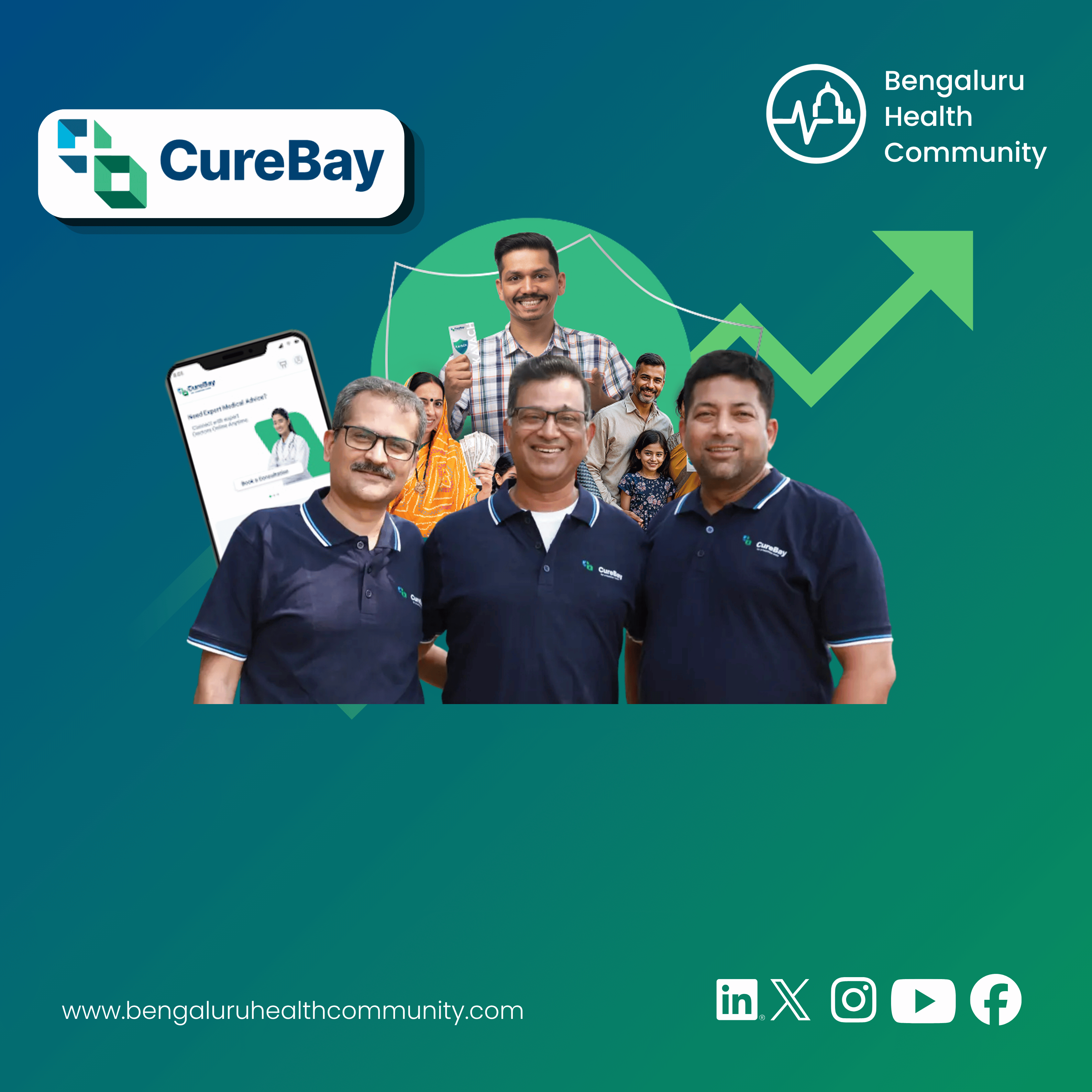
CureBay Raises ₹100 Crore in Pre-Series C to Scale its Six-Layer Rural Healthcare Network Across India
By Mustafa Shariff, Editor in Chief · October 23,2026 · 2 mins read
Summary
- CureBay raises ₹100 crore Pre-Series C led by IvyCap Ventures to expand rural clinic network across India
- Rural healthcare startup CureBay has raised ₹100 crore in a Pre-Series C round led by IvyCap Ventures, with debt from Trifecta Capital, Alteria Capital, and VentureSoul Partners. The funding will expand its 250+ clinic network to Andhra Pradesh and strengthen AI-powered health screening capabilities.
"Rural India does not have a healthcare access problem alone — it has a care-coordination problem. CureBay is solving both, one clinic at a time."
CureBay was founded in 2021 by Priyadarshi Mohapatra, Shobhan Mahapatra, and Sanjay Swain, all of whom had firsthand experience with India's rural healthcare failure: patients in underserved areas who needed a cardiologist were travelling three to five hours to a city, arriving with advanced disease, and returning with unaffordable bills. CureBay was built to create a care pathway that allows a patient in a tier-3 district to be screened locally, diagnosed remotely (with specialist support), and referred seamlessly for in-person care when needed — without making a single unnecessary trip. The company operates from Bhubaneswar, Odisha, and currently serves patients across Odisha, Jharkhand, Bihar, West Bengal, Chhattisgarh, Madhya Pradesh, and Rajasthan.
The Six-Layer Care Architecture
CureBay describes its model as a six-layer system, each layer adding a service dimension the one below it cannot provide alone. Layer one is the physical clinic: 250+ technology-enabled centres that include diagnostic equipment, point-of-care testing, and medicines. Layer two is the Swasthya Mitra (community health worker) network: trained local women who act as first-contact health guides, conduct home visits, and flag high-risk patients to the clinic. Layer three is the clinical staff and doctor-partner network: full-time and part-time doctors at or supporting the clinics. Layer four is the digital platform: the patient app and clinic management system that maintains longitudinal health records, manages referrals, and provides teleconsultation. Layer five is the 24/7 command centre: a central triage and monitoring hub that tracks real-time clinic metrics, manages specialist consultations, and escalates emergencies. Layer six is CureBay Kavach: the company's preventive health membership product, which bundles doctor visits, diagnostics, and a monitoring programme into an annual subscription that rural families can afford.
The Round: ₹100 Crore, Equity and Debt
The Pre-Series C totals ₹100 crore and is structured as a combination of equity and debt — a financing approach increasingly common for stage-appropriate rural health companies that have predictable revenue from clinic operations and government partnerships. IvyCap Ventures, a Pune-based VC firm focused on India-first technology companies, led the equity tranche of ₹69 crore, joined by existing investors. The debt tranche of over ₹30 crore came from three specialist venture debt providers: Trifecta Capital, one of India's most active venture debt funds; Alteria Capital, which focuses on growth-stage venture debt for technology companies; and VentureSoul Partners. CureBay's previous raise was a $21M (approximately ₹175 crore) Series B in May 2025, led by Bertelsmann India Investments, with Elevar Equity and British International Investment. Total funding to date crosses ₹275+ crore.
Scale and Impact: 17 Lakh Patients, 400 Health Camps Monthly
By the numbers CureBay disclosed alongside this raise: over 17 lakh (1.7 million) patients served since inception; over 400 health camps held monthly; and the Samriddhi Kendra partnership — a government-sponsored rural wellness centre initiative — in which CureBay serves as a healthcare delivery partner. The clinic count of 250+ across seven states makes CureBay one of the largest proprietary rural clinic networks in India by footprint. For context, the National Health Mission's Sub-Centre model has over 1.5 lakh sub-centres across India — CureBay is not competing with that infrastructure, but complementing it by providing the technology layer, specialist access, and diagnostics that government sub-centres structurally cannot.
Use of Funds: Andhra Pradesh and AI
The two primary uses of the ₹100 crore raise are geographic expansion into Andhra Pradesh — which has a large rural population with significant unmet healthcare access needs, particularly in Rayalaseema and North Andhra districts — and technology deepening. On the AI side, CureBay has been building capabilities in automated health screening (using patient vitals, symptom patterns, and demographic data to flag at-risk patients before they present with advanced disease), AI-powered clinical decision support (assisting doctors at rural clinics who may not have specialist training), and patient health insights (longitudinal data analytics that allow the command centre to proactively outreach to patients whose risk profile is changing). These capabilities are designed to make the per-clinic productivity higher as the network scales.
BHC Perspective: The Rural Health Access Imperative
Bengaluru Health Community's members include a significant number of hospital leaders, health system operators, and investors focused on the question of whether quality healthcare can be made reliably accessible in non-urban India. CureBay's model is an answer worth watching: it combines primary care infrastructure (physical clinics) with specialist access technology (teleconsultation, AI triage) and community health workers (Swasthya Mitras) in a way that is both scalable and government-partnerable. The Samriddhi Kendra tie-up, in particular, signals that CureBay's model is considered credible enough by state government health authorities to serve as an implementation partner — a meaningful de-risking of its growth path. For BHC members exploring rural health investment or operations, CureBay represents one of the most mature end-to-end models currently being built in India.
Frequently Asked Questions
Q: How does CureBay's model differ from a standard telemedicine app?
A: Telemedicine apps (Practo, MFine, Apollo 247) connect patients to doctors digitally — they require the patient to own a smartphone, have an internet connection, and be able to describe their symptoms accurately without in-person examination. CureBay operates physical clinics with diagnostic equipment and clinical staff, which means a patient can have a blood test, an ECG, or a vitals check done at the clinic, with the results uploaded in real-time for the remote doctor to review. The Swasthya Mitra network identifies patients who have not self-referred, bringing proactive care to families who would otherwise not access any healthcare. The combination of physical infrastructure, community health workers, and digital technology is what differentiates CureBay from a pure telemedicine model.
Q: What is venture debt and why is it appropriate for CureBay at this stage?
A: Venture debt is a non-dilutive form of growth capital, typically structured as a term loan repayable over 2–4 years with an interest rate and a small equity component (a warrant). It is appropriate for companies that have predictable, contracted revenue — like CureBay's government partnerships and membership subscriptions — and do not want to dilute founders and existing investors for capital that has a defined payback horizon. For CureBay, the ₹30+ crore in venture debt from Trifecta, Alteria, and VentureSoul is likely being used for clinic capex (equipment, setup costs) and working capital, where the payback can be modelled against per-clinic revenue. The equity component funds higher-risk growth investments like the AI platform and new state entry.
Q: Is rural healthcare investment commercially viable in India?
A: The commercial viability of rural healthcare has been questioned for decades in India, primarily because average revenue per patient is substantially lower than in urban settings (rural patients' ability to pay is constrained), and the capex and opex of running a quality clinic in rural areas is not proportionally lower. What CureBay has done — and what its Series B from Bertelsmann India and BII signals — is demonstrate a model that generates sufficient revenue per clinic to be commercially sustainable at the unit level, before scaling costs. The government partnership (Samriddhi Kendra) partially de-risks the revenue by providing a guaranteed patient flow and potentially a fixed-fee per consultation. The combination of government-contracted and out-of-pocket revenue, at a capital-efficient clinic design, is what makes the model financeable.