Funding News
Clinics On Cloud Raises ₹120 Crore in Series A at ₹600 Crore Valuation to Take its Health ATM and Microclinic Network Global
By Mustafa Shariff, Editor in Chief · November 02,2026 · 2 mins read
Summary
- Clinics On Cloud raises ₹120 crore Series A from Model42 at ₹600 crore valuation to expand health ATM and microclinic network globally
- Pune-based health-tech company Clinics On Cloud has raised ₹120 crore in a Series A round at ₹600 crore valuation from Dubai-based investor Model42. Founded in 2018, the company operates Health ATMs, AI-enabled Health Lounges, Box Clinics and Mobile Medical Units, and plans to expand to UAE, Africa, US and Southeast Asia.
"We are not building another hospital. We are building the infrastructure that sits in every neighbourhood, every office, every airport — the first touchpoint of preventive healthcare for a billion people."
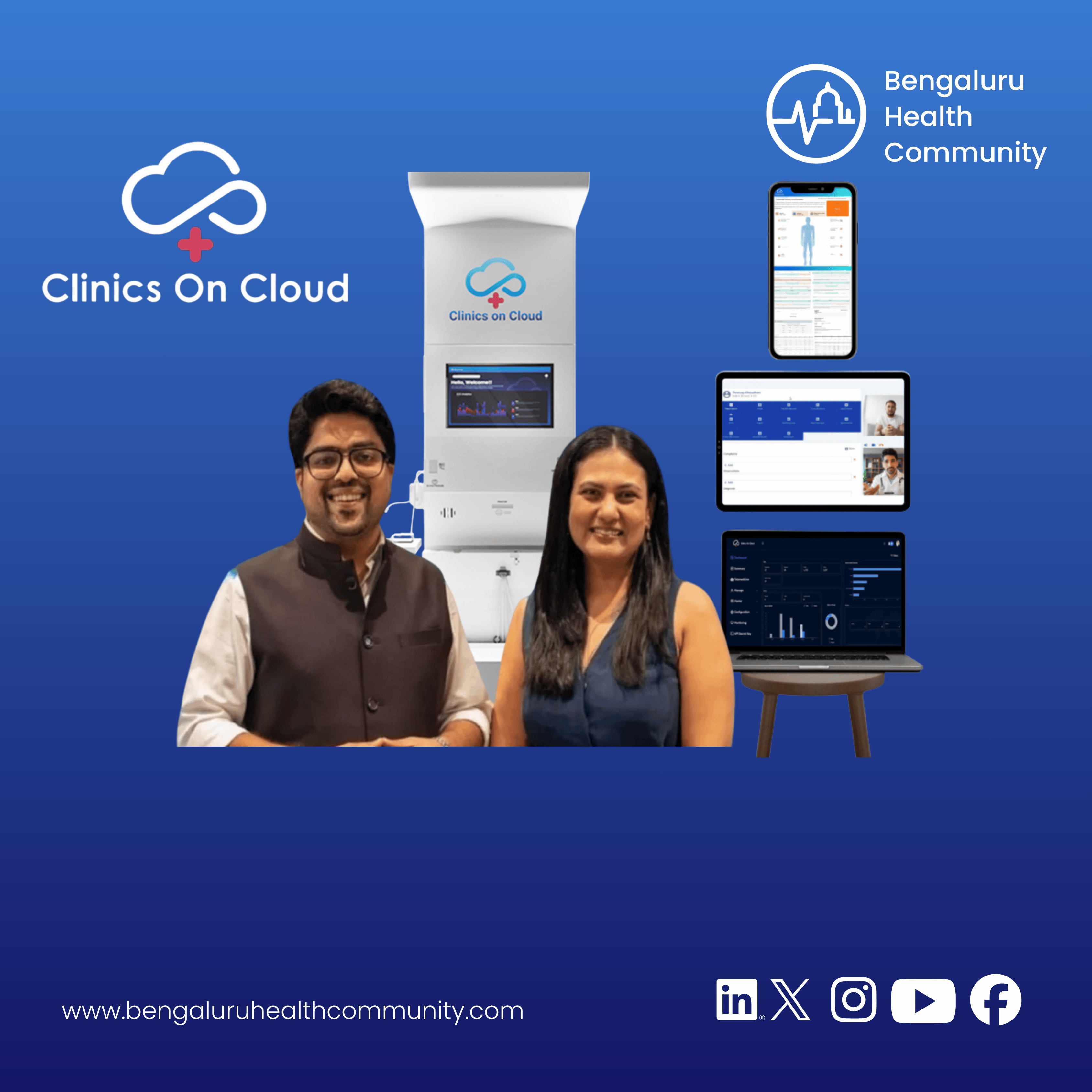
Clinics On Cloud was founded in 2018 by Abhay Agarwal and Manashrri Agarwal, a husband-and-wife team based in Pune. The company's thesis is that India's primary healthcare access problem is not primarily a doctor shortage — it is a physical infrastructure problem. There are not enough entry-points where a person can check their blood pressure, get a basic blood test, consult a doctor, and receive a prescription, without travelling to a hospital or clinic and waiting in a queue. Clinics On Cloud builds compact, technology-enabled healthcare delivery points designed to fill these gaps: the Health ATM (a kiosk-sized unit with 30+ diagnostic parameters, designed for placement in apartments, offices, pharmacies, and public spaces), the AI-enabled Health Lounge (a larger, more comprehensive unit with AI-driven triage and teleconsultation), the Box Clinic (a portable, modular clinical unit for temporary or mobile deployment), and the Mobile Medical Unit (a vehicle-mounted diagnostic and consultation facility for rural or remote areas). All four product lines connect to a cloud-based platform that maintains patient records, enables remote consultation, and generates population-level health insights for employers, housing societies, or government agencies that deploy the units.
The ₹120 Crore Series A: Model42 and the Dubai Connection
The ₹120 crore Series A round was raised from Model42, a Dubai-headquartered healthcare investment platform. Model42 was co-founded by Timur Kudratov, Dr. Aida Sheikhaliyeva, and Dr. Raees Tonse. The name Model42 is a reference to the 42nd parallel of latitude — a symbolic nod to the geographic breadth of the firm's healthcare investment mandate, which spans the Middle East, South Asia, and Africa. For Clinics On Cloud, the Model42 relationship is not just financial — the investor's UAE presence and network positions Clinics On Cloud directly in its target market for international expansion. The ₹600 crore (approximately $72 million) post-money valuation positions Clinics On Cloud as one of the better-capitalised health kiosk companies in India, in a segment that has attracted interest from large corporates (Apollo Pharmacy has deployed health kiosks), telecom companies (Jio Health ATMs), and government schemes (Ayushman Bharat's Health and Wellness Centres).
The Microclinic Model: Why Distributed Health Infrastructure Is Strategic
Clinics On Cloud's model addresses a structural gap in India's primary care landscape: the absence of preventive health infrastructure at the neighbourhood level. India has approximately 8.5 lakh (850,000) registered allopathic doctors, approximately 1 per 1,000 people — close to the WHO benchmark — but these doctors are concentrated in urban areas (metros, tier-1 cities), while rural and semi-urban India remains significantly under-served. At the same time, non-communicable diseases (NCDs) — hypertension, diabetes, thyroid disorders, obesity — are growing fastest in precisely these under-served populations, because primary detection and monitoring is absent. A Health ATM unit deployed in a housing society in Tier-2 Pune or in a government office in Nashik allows someone to check their vitals (blood pressure, blood glucose, SpO2, temperature, BMI, heart rate) and consult a doctor remotely — potentially catching a hypertension or pre-diabetic state years before it would have presented at a hospital. The employer and housing society deployment model generates a recurring revenue stream (monthly subscription per unit + per-consultation fees) that is institutionally contractible, unlike individual patient footfall.
Global Expansion: UAE First, Then Africa and the US
The primary use of the Series A proceeds is international market expansion. The UAE is Clinics On Cloud's first target: the country has a large South Asian diaspora, a regulatory environment receptive to medical technology innovation (the Dubai Healthcare City free zone and Abu Dhabi's G42 Healthcare ecosystem both actively attract healthtech companies), and a high willingness-to-pay for preventive health services. Model42's local presence in Dubai makes the UAE entry significantly lower-risk than a standalone market entry would be. After the UAE, Clinics On Cloud has identified Sub-Saharan Africa (specifically Nigeria, Kenya, and South Africa) as a high-priority expansion target: the continent has an acute primary healthcare infrastructure deficit, a growing mobile health ecosystem, and a rapidly urbanising middle class. The US is a longer-term target — regulatory complexity (FDA clearance for diagnostic devices) and market access costs make it a 3–5 year horizon rather than an immediate one.
AI-Driven Diagnostics: The Technology Layer
Beyond the hardware (kiosks and mobile units), Clinics On Cloud's competitive differentiation is in its AI-driven diagnostics layer. The platform uses computer vision and machine learning to analyse vital sign patterns, flag abnormal readings for clinical review, and generate risk stratification scores that allow the remote consulting doctor to prioritise high-risk patients. The AI triage function is particularly important in the unmanned Health ATM model, where there is no healthcare professional present at the point of deployment — the system must independently decide whether a patient's reading warrants immediate teleconsultation or can be deferred. The company has also announced plans to build AI-driven diagnostic imaging capabilities for the Health Lounge product, enabling basic imaging (electrocardiography, spirometry, eye diagnostics) with AI interpretation.
BHC Perspective: The Microhealth Infrastructure Opportunity
For the BHC community — which includes both hospital operators and healthtech investors — Clinics On Cloud's raise is a signal that distributed, asset-light primary care infrastructure is becoming a financeable category. The traditional hospital sector in India is concentrated at the tertiary and secondary level; primary care is fragmented, informal (most primary care is delivered by small private clinics and chemist shops), and under-digitised. Companies like Clinics On Cloud, CureBay (which raised ₹100 crore earlier this month), and Portea Medical are building the digital primary care layer that sits between the patient and the hospital — what the industry is beginning to call "micro-health infrastructure." For BHC members in the hospital operations space, the growth of this infrastructure creates both a referral pipeline (patients detected early at a Health ATM and referred for further workup) and a competitive dynamic (as microclinics improve, some procedures that would previously have required a hospital visit can be handled remotely). The Model42 connection also opens a corridor for Indian healthtech companies to access Gulf capital and market entry support — a route BHC has been actively building through its own Gulf-focused partnerships.
Frequently Asked Questions
Q: What is a Health ATM and how is it regulated in India?
A: A Health ATM is a kiosk-sized device that contains sensors to measure multiple health parameters — blood pressure (BP cuff), blood glucose (fingerprick or non-invasive), SpO2 (pulse oximeter), temperature (infrared thermometer), weight and BMI (scale), and in more advanced models, ECG, haemoglobin, and lipid panels. In India, Health ATMs are regulated as medical devices under the Medical Devices Rules, 2017 (amended 2020) administered by the Central Drugs Standard Control Organisation (CDSCO). Each sensor or diagnostic test incorporated in the device requires its own regulatory clearance as a medical device. Companies selling or operating Health ATMs must ensure their devices and tests are either Class A (low risk, self-declared) or have received explicit CDSCO approval for higher-risk diagnostic tests. The teleconsultation component is additionally regulated under the Telemedicine Practice Guidelines 2020 issued by the Medical Council of India. This dual regulatory requirement (device approval + telemedicine compliance) is a meaningful entry barrier that favours established players like Clinics On Cloud over new entrants.
Q: How does Clinics On Cloud generate revenue?
A: Clinics On Cloud operates a B2B2C model: it sells or deploys its Health ATMs, Health Lounges, Box Clinics, and Mobile Medical Units to institutional clients — corporate offices (for employee wellness), housing societies (resident preventive health), government health departments, pharmacies, and airports — and charges a combination of a monthly subscription fee per unit (for maintenance, software, and clinical oversight) plus a per-consultation fee when a patient uses the teleconsultation function. Some institutional clients (corporates, government) pre-purchase consultation credits or pay a fixed monthly fee per enrolled population. Consumers pay per test or per consultation when using the devices in public spaces (airports, malls, pharmacies). The recurring nature of the subscription and consultation revenue — as opposed to one-time hardware sales — is what makes the model scalable and attractive to investors.
Q: Who are Clinics On Cloud's competitors in India?
A: The health kiosk and microclinic segment in India has several players at different scale levels. Apollo Pharmacy has deployed health kiosks (VHealth) at its pharmacy locations. Jio Health has announced Health ATM deployments. HealthCube (Bengaluru-based) builds portable diagnostics devices used in healthcare settings. Healthians (now Tata 1mg's diagnostics arm) does home sample collection, which competes for the preventive diagnostics wallet. The Government of India's Ayushman Arogya Mandir (formerly Health and Wellness Centres) scheme is rolling out primary healthcare points across rural areas — the largest "microclinic" network in India by sheer deployment numbers, though government-operated and not commercially competitive. Clinics On Cloud differentiates on its product breadth (four product lines covering different deployment contexts), the AI diagnostics layer, and now its international expansion focus, which none of the above players have announced at scale.