Funding News
Cent Raises $15 Million Series A to Scale Its Full-Body AI Health Screening Platform and Acquire Medsee, an AI Radiology Tool
By Mustafa Shariff, Editor in Chief · November 02, 2026 · 2 mins read
Summary
- Cent raises $15 million Series A led by Blume Ventures and South Park Commons for AI-powered preventive health screening platform
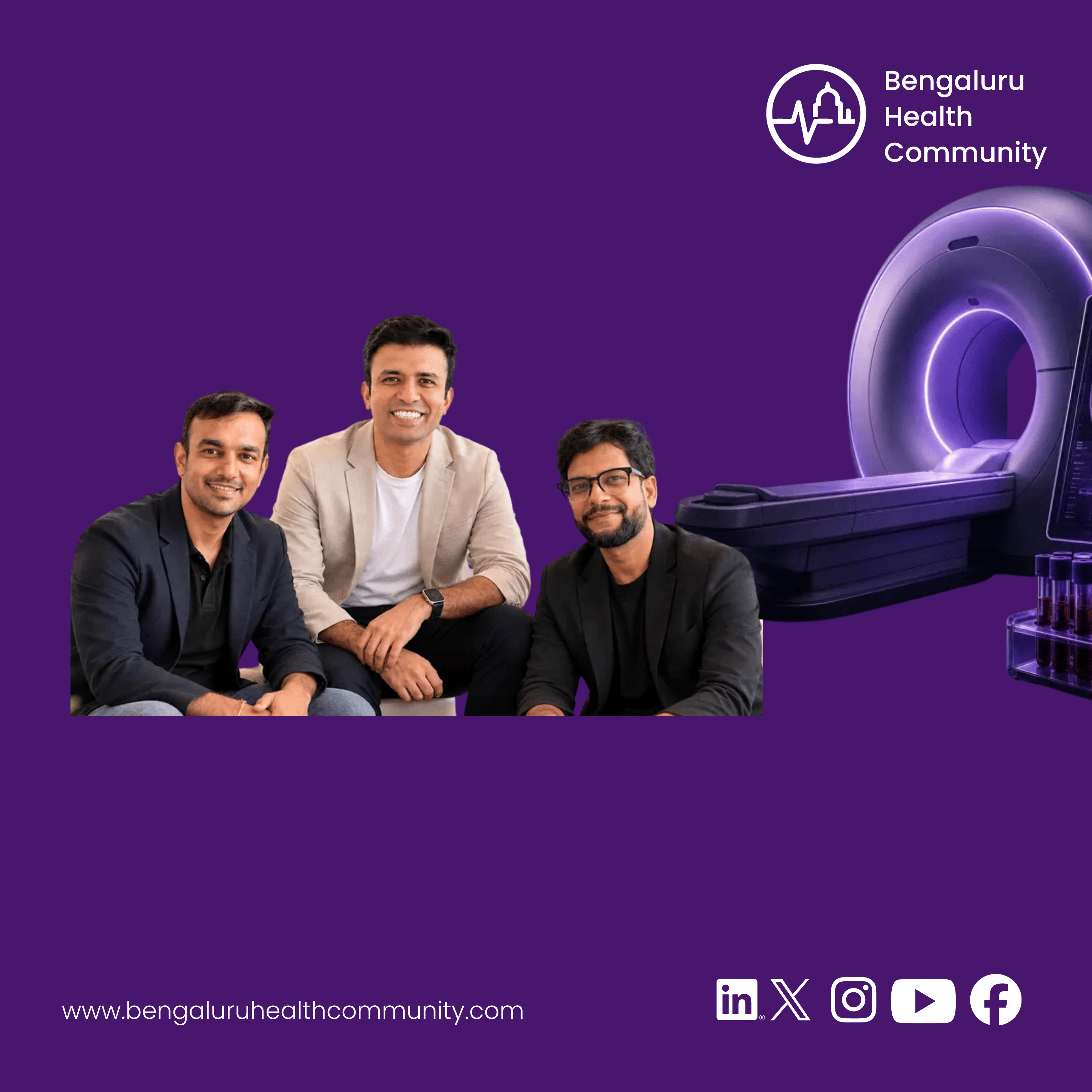
- Cent, a preventive health intelligence company co-founded by Practo's Shashank ND, raised $15 million in a Series A round co-led by Blume Ventures and South Park Commons. Its Cent Check combines full-body MRI, CT, DEXA, ECG, and 100+ biomarkers in a 2-hour visit powered by AI. It also acquired Medsee, an AI radiology platform.
"One in four people who walked into Cent feeling healthy left with a finding that required medical action. One in forty needed attention immediately. That is the case for preventive health intelligence — not wellness, not fitness, health."
Cent is a preventive health intelligence company, not a diagnostics lab or a wellness app. The distinction matters: preventive health intelligence means using comprehensive, protocol-driven medical imaging and biomarker analysis to identify latent disease risk in people who have no symptoms and feel healthy. Cent's flagship product — Cent Check — combines full-body MRI, low-dose CT (computed tomography), DEXA (dual-energy X-ray absorptiometry for bone density and body composition), ECG, echocardiogram, and a panel of over 100 blood biomarkers, all consolidated in a visit of approximately two hours. Results are processed under Cent's proprietary CCNM (Cent Comprehensive Numeric Model) protocol, which consolidates imaging findings and biomarker data into a structured health intelligence report reviewed by specialist doctors. Each member receives a doctor-led health plan with year-round follow-up and access to clinical support. This is a model with clear international precedents — Human Longevity Inc. (US), Prenuvo (US/Canada), and Grail (liquid biopsy, US) — adapted for the Indian market, where early-stage chronic disease detection is severely underserved and the NCD burden is among the world's highest.
The Founding Team: Practo DNA and Consumer Brand Experience
Cent's founding team is notable for combining deep healthcare operator experience (Shashank ND built Practo from a small Bengaluru startup into India's largest doctor-appointment platform, then founded OneFlow Holdings) with consumer brand and product expertise (Anshul Khandelwal was CMO of Ola Electric during its rapid growth phase; Arpit Garg was Product Head at Lenskart). This combination — deep healthcare credibility plus consumer-brand distribution capability — is the key to why investors backed a 2025-founded company at Series A speed in a category (full-body health screening) that has historically struggled with customer acquisition in India. Cent is treating preventive scanning as a product that a busy, health-aware urban professional wants to purchase, not as a medical procedure that requires a doctor's referral to initiate.
The Funding: Blume + South Park Commons, and Notable Angels
The $15 million Series A was co-led by Blume Ventures — one of India's most respected early-stage technology funds (portfolio includes Unacademy, Slice, Dunzo, and multiple healthtech companies) — and South Park Commons, a San Francisco-based founder community and investor that had backed Cent in an earlier round. The round included both equity and debt, and notable individual investors: Arun Sarin (former CEO of Vodafone Group — a major validator of the global scalability thesis), Srinivas Narayanan (former B2B CTO at OpenAI — validation from the AI infrastructure side), and Aprameya Radhakrishna (founder of TaxiForSure and Koo). The Blume co-lead is particularly significant for the BHC community: Blume has been one of the most active healthtech investors in India over the past five years, and a Blume Series A typically signals a company has demonstrated initial unit economics and is ready for scale.
The Medsee Acquisition: Building the AI Radiology Layer
Alongside the funding announcement, Cent disclosed the acquisition of Medsee — an AI radiology reporting platform founded by Chitra Singh. Medsee uses AI to draft structured radiology reports for review and sign-off by qualified radiologists, reducing the time and cognitive load on radiologists who must process large volumes of imaging. The acquisition is strategically logical: Cent's Cent Check generates a large volume of high-complexity imaging (full-body MRI, CT, echocardiogram) per member, and the bottleneck in scaling a comprehensive scanning model is not the scanner hardware — it is the radiologist time required to interpret and report results. By integrating Medsee's AI drafting capability into its own clinical workflow, Cent can increase radiologist throughput, reduce report turnaround time, and maintain clinical quality at scale. For the broader Indian radiology ecosystem, this is a signal of where AI radiology tools are heading: from standalone report-generation products to integrated clinical workflow layers embedded within health platforms.
What the Data Says: 1 in 4, 1 in 40
Cent's most striking public data point is from its first 10,000 whole-body scans conducted across Bengaluru, Mumbai, and Delhi: one in four members who presented as healthy and asymptomatic had a finding that required medical action. One in forty required immediate medical attention. These numbers are consistent with international literature on comprehensive health screening in asymptomatic populations — studies from Prenuvo and Human Longevity have shown similar incidental finding rates. What the numbers demonstrate is that the population Cent is targeting (urban, relatively affluent, health-aware professionals who believe they are healthy) is not, in fact, uniformly healthy — and that the absence of symptoms is not a reliable indicator of the absence of disease. This is Cent's core value proposition, and these numbers are the most powerful piece of evidence it can put in front of a potential member.
BHC Perspective: The Preventive Health Screening Opportunity in India
For BHC members — hospital operators, healthtech investors, and clinical professionals — Cent's raise represents a pivotal moment for the preventive health screening category in India. Until recently, comprehensive health check-ups in India meant a package of blood tests and a basic ultrasound at a diagnostics chain (Thyrocare, Metropolis, Dr. Lal PathLabs) — rigorous for routine monitoring, insufficient for early disease detection. Cent is building a different category: comprehensive, AI-powered, imaging-heavy, membership-based screening for early disease identification in asymptomatic individuals. The competitive landscape is still nascent: Ultrahuman (metabolic monitoring wearables), Loop Health (employer benefits), and a handful of longevity clinics exist, but no Indian company has yet achieved scale in Cent's specific model. The BHC connection is direct: preventive health screening drives hospital referrals (a member who receives a Cent finding requiring follow-up cardiac workup, oncology review, or surgical intervention is a referral to BHC's hospital network), and the AI diagnostics layer (Medsee) is a category where BHC's hospital members are actively evaluating tools.
Frequently Asked Questions
Q: How does Cent differ from a standard corporate health check-up package?
A: A standard corporate health check-up in India typically includes a complete blood count (CBC), liver function test (LFT), kidney function test (KFT), lipid panel, thyroid panel, blood glucose, urine analysis, chest X-ray, and sometimes a basic abdominal ultrasound. This takes 2–4 hours and costs ₹2,000–8,000 at a diagnostics chain. It is optimised for detecting common, easily measurable conditions (anaemia, diabetes, dyslipidaemia, thyroid disorders) and is not designed to detect early-stage cancers, cardiovascular structural abnormalities, organ lesions, or neurodegenerative changes. Cent Check, by contrast, includes a full-body MRI (which images all major organ systems and can detect early lesions, lymphadenopathy, organ abnormalities, and vascular changes not visible on ultrasound), low-dose CT (for pulmonary nodules, coronary artery calcium scoring), DEXA (precise bone density and body composition), ECG and echocardiogram (structural cardiac assessment), and 100+ biomarkers (including markers not in standard panels, such as inflammatory markers, advanced lipid fractions, and organ-specific enzymes). The focus is on finding things that a standard check-up would miss in a person who has no symptoms — the hidden disease burden.
Q: Is a full-body MRI safe, and how long does it take?
A: MRI (magnetic resonance imaging) uses magnetic fields and radio waves — it does not use ionising radiation (unlike X-rays or CT scans), making it one of the safest imaging modalities. Repeated MRI scans over years carry no known cumulative risk. A full-body MRI for a health screening protocol typically takes 60–90 minutes in the scanner; Cent's total visit is approximately 2 hours including preparation, the MRI, and the other tests (CT, DEXA, ECG, blood draw). The main contraindications to MRI are metal implants (some pacemakers, cochlear implants, certain surgical clips) that are unsafe in a magnetic field — patients with these implants may be ineligible. Modern MRI protocols have also reduced the claustrophobia risk significantly with wider-bore scanners and shorter sequence times. Low-dose CT does use ionising radiation, but at a dose equivalent to approximately 1–3 months of background radiation — considered acceptable for a once-yearly screening protocol in adults over a certain age or risk level.
Q: What happens when Cent finds something — how does the referral and follow-up work?
A: When Cent's AI-assisted radiology and specialist doctors identify a finding in a member's scan or biomarkers, the findings are classified by urgency: immediate (requires urgent clinical attention, e.g. a pulmonary embolism or a large mass), actionable (requires follow-up workup, specialist consultation, or monitoring), and informational (noted for tracking, no immediate action required). For immediate findings, Cent contacts the member directly and facilitates urgent specialist referral. For actionable findings, the member's doctor-led health plan includes specific next steps — a specialist consultation, a follow-up scan at a defined interval, or a lifestyle intervention with monitoring. Cent maintains a year-round support model where members can access the clinical team for questions about their findings and health plan. The referral pathway (to which hospitals and specialists) is an area where partnerships with hospital networks like BHC's could add significant value — a Cent finding that requires a hepatobiliary surgery consult, a cardiac catheterisation, or an oncology tumour board review is a referral that needs a trusted hospital pathway.