Funding News
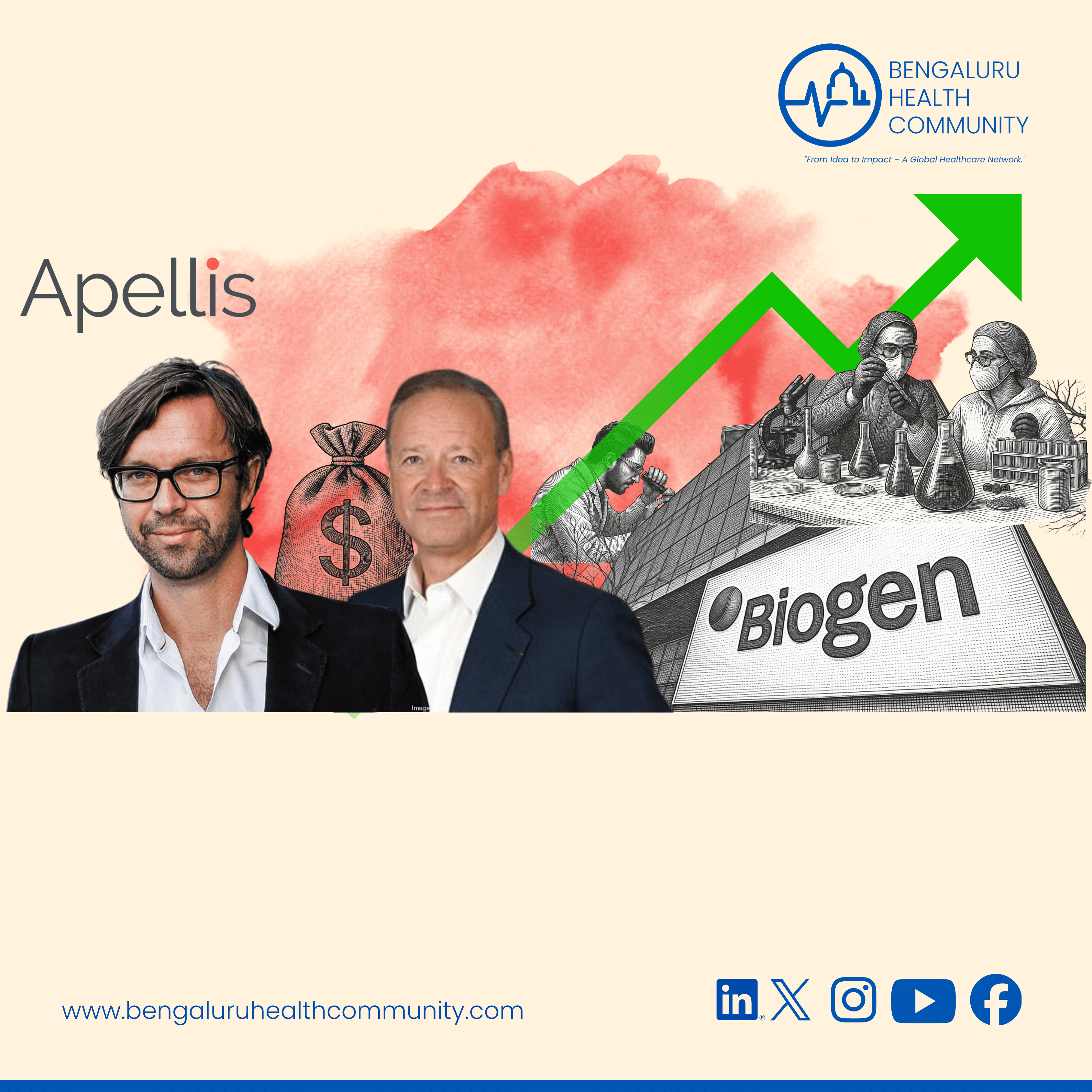
Biogen Is Paying $5.6 Billion for Apellis Pharmaceuticals — Two Approved Complement Inhibitors, Nephrology Pipeline, and a Bet on the Next Era of Immune Disease Treatment
By Mustafa Shariff, Editor in chief · May 01, 2026 · 5 min read
Summary
- Biogen's $5.6 Billion Apellis Acquisition: The Complement Pathway Deal That Reshapes Immunology Treatment
- Biogen has agreed to acquire Apellis Pharmaceuticals for approximately $5.6 billion. Here is the full story of the complement pathway bet and what it means for global and Indian immunology treatment.
"The opportunity to bring in two early-launch commercial assets into the portfolio, from a growth perspective, is really important to us. Being able to do that in a manner where there is that immuno-crossover sets us up very nicely for the felzartamab asset."
Biogen has entered a definitive agreement to acquire Apellis Pharmaceuticals for $41 per share in cash — a total transaction value of approximately $5.6 billion — with shareholders also eligible for additional payments of up to $4 per share tied to sales milestones for Apellis's lead product, Syfovre. The acquisition brings two approved commercial-stage therapies into Biogen's portfolio and adds a scientifically coherent pipeline extension in nephrology that connects to Biogen's own late-stage asset felzartamab.
The deal represents Biogen's largest acquisition since its purchase of Reata Pharmaceuticals in 2023, and it marks a significant strategic pivot for a company that has historically been associated almost exclusively with neuroscience. The complement pathway — the biological mechanism targeted by Apellis's therapies — is a fundamentally different territory from Alzheimer's disease and multiple sclerosis. But the strategic logic is coherent: Biogen's CFO Robin Kramer explained that the acquisition provides valuable early-launch commercial assets from a growth perspective and creates immunological crossover capabilities that position the company for its upcoming felzartamab launch.
The Complement Pathway and Why It Matters
The complement system is one of the immune system's most ancient and powerful defence mechanisms — a cascade of approximately 50 proteins that, when activated, can destroy pathogens, promote inflammation, and recruit immune cells to sites of infection or injury. In healthy conditions, the complement cascade is tightly regulated. In a growing number of diseases, this regulation fails: complement becomes chronically activated, directing immune destruction at the body's own tissues rather than external threats.
Apellis has built its business on inhibiting C3 — the central activation point of the complement cascade — using a drug called pegcetacoplan. By targeting C3, pegcetacoplan blocks all three arms of the complement pathway simultaneously, creating a broader therapeutic effect than drugs targeting downstream complement components. This mechanism has been validated in two distinct disease settings, producing two FDA-approved therapies.
The Two Approved Products
Syfovre (pegcetacoplan) is the first FDA-approved treatment for geographic atrophy — the advanced form of age-related macular degeneration that leads to progressive, irreversible central vision loss. Geographic atrophy affects an estimated 5 million people in the US and Europe, and until Syfovre's approval, there was no approved treatment that could slow its progression. Syfovre is administered as an intravitreal injection and has demonstrated slowing of the rate of GA lesion growth in Phase 3 trials. Analysts had estimated significant revenue growth potential for Syfovre as prescribing patterns mature.
Empaveli (pegcetacoplan) is the same molecule formulated for subcutaneous administration and approved for paroxysmal nocturnal haemoglobinuria — a rare, life-threatening blood disorder in which complement-mediated destruction of red blood cells leads to haemolytic anaemia, blood clots, and multi-organ complications. PNH affects approximately 1-1.5 patients per million population globally.
The Felzartamab Connection and Nephrology Strategy
The acquisition's strategic depth is most visible in the nephrology connection. Biogen has been developing felzartamab — an anti-CD38 antibody — for antibody-mediated rejection (AMR), a form of organ rejection mediated by donor-specific antibodies that affects kidney transplant patients. Apellis's nephrology pipeline includes complement-mediated kidney disease programmes that work on the same immunological pathways as felzartamab, creating scientific and commercial complementarity. With AMR launches expected beginning in 2027, the Apellis team brings nephrology expertise and complement biology capability that Biogen would otherwise need to build from scratch.
Implications for India
India has significant burden from both complement-mediated eye disease and rare haematological conditions including PNH. Geographic atrophy is the terminal stage of age-related macular degeneration — India's ageing population will generate substantial demand for effective GA treatments as awareness and diagnostic capability improve. PNH is treated at a limited number of haematology centres in India, primarily through existing complement inhibitors like eculizumab.
The Biogen-Apellis deal accelerates the development of the next generation of complement-targeted therapies. For India, the timeline from approval to access typically runs 3-5 years for specialty and orphan disease drugs. Understanding what is in global pipelines — and advocating proactively for faster approval pathways — is the mechanism through which Indian patients can access these innovations sooner.
BHC Perspective
At Bengaluru Health Community, the Biogen-Apellis acquisition is a story about the complement pathway becoming one of the most commercially significant immunological territories in global pharma. For BHC founders building in ophthalmology AI (GA detection), rare disease platforms, or nephrology technology — the commercial validation of this disease territory by a $5.6 billion transaction is the market signal that reinforces their opportunity.
Frequently Asked Questions
Q: What did Biogen acquire from Apellis?
A: Biogen agreed to acquire Apellis Pharmaceuticals for approximately $5.6 billion ($41/share, 86% premium). Apellis has two FDA-approved complement inhibitors: Syfovre (pegcetacoplan) for geographic atrophy (advanced macular degeneration) and Empaveli for paroxysmal nocturnal haemoglobinuria (PNH).
Q: What is the complement pathway and why is it significant?
A: The complement system is an immune cascade whose dysregulation drives diverse diseases — geographic atrophy, PNH, antibody-mediated rejection, kidney disease. Targeting C3 (the central activation point) blocks all three complement arms simultaneously. Apellis's pegcetacoplan is the first commercial validation of C3 inhibition as a therapeutic strategy.
Q: Why does the Apellis acquisition fit Biogen's strategy?
A: The deal brings early-launch commercial growth assets, nephrology expertise aligned with felzartamab's upcoming launch in antibody-mediated rejection, and complement biology capabilities that create immunological synergy across Biogen's portfolio.