AI in Healthcare
Apollo Just Opened Its 76th Hospital — A 400-Bed AI-Integrated Smart Facility in Hyderabad's Financial District, Inaugurated by the Chief Minister
By Mustafa Shariff, Editor in Chief · May 08 , 2026 · 5 min read
Summary
- Apollo's 76th Hospital in Hyderabad: Inside India's New Standard for AI-Integrated Hospital Infrastructure
- Apollo Hospitals has opened its 76th facility — a 400-bed AI-integrated smart hospital in Hyderabad's Financial District, inaugurated by CM Revanth Reddy. Here is the full story of what makes this hospital different.
"When we build a hospital, we are building far more than infrastructure — we are building hope. This facility brings together the most advanced diagnostic and therapeutic capabilities with the warmth and compassion that defines Apollo's approach to care."
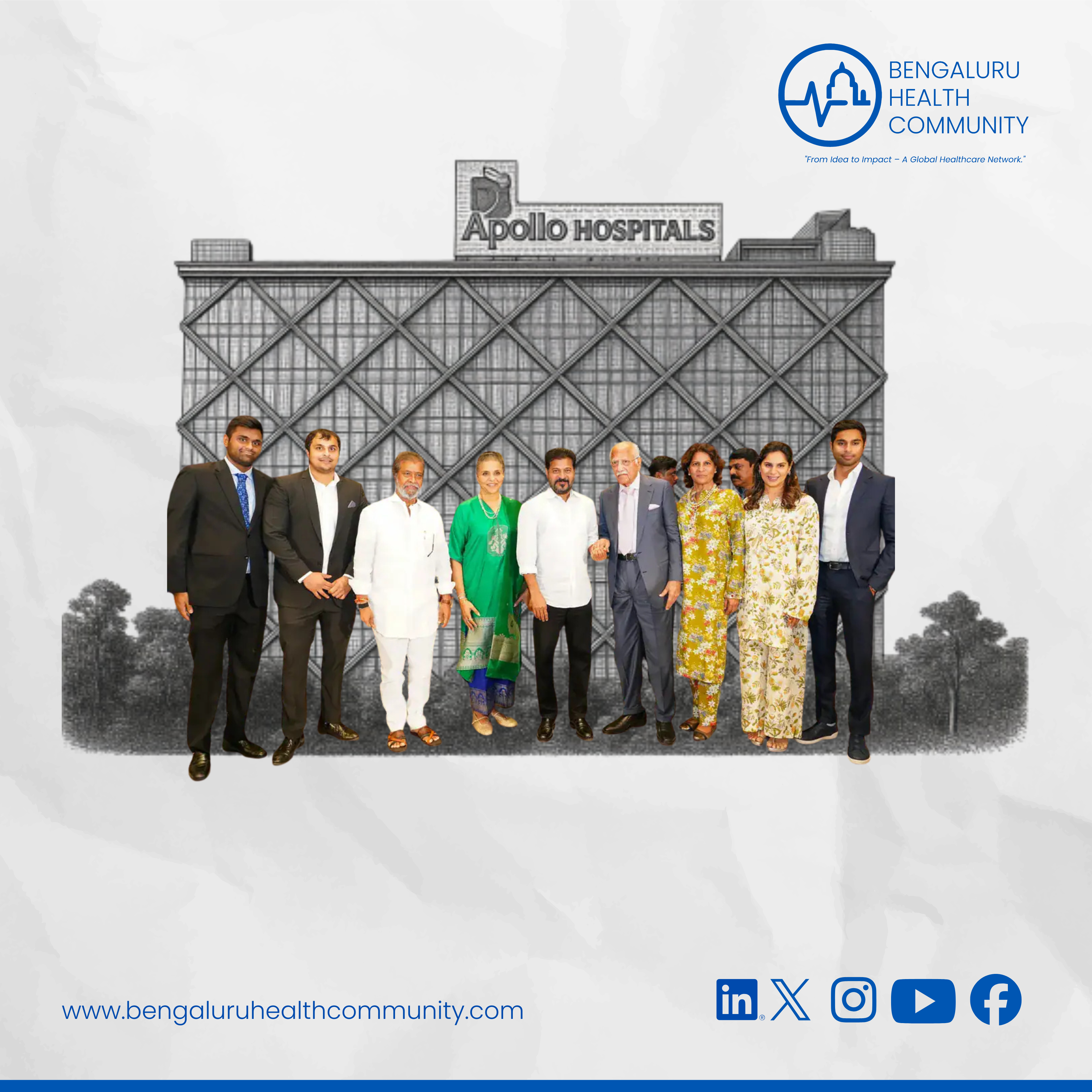
Apollo Hospitals Group has expanded its national network to 76 hospitals with the inauguration of a 400-bed next-generation smart facility in Hyderabad's Financial District — one of the city's most rapidly growing commercial and residential corridors. The hospital was inaugurated by Telangana Chief Minister Revanth Reddy on April 29, 2026, alongside Health Minister Damodar Rajanarsimha and MLA Arekapudi Gandhi, underlining the state government's recognition of Apollo's continued investment in Telangana's healthcare infrastructure.
The Financial District location is deliberate. Hyderabad's Financial District — home to a dense concentration of technology companies, financial services firms, and their workforces — has historically been underserved by tertiary healthcare relative to the density and income profile of its resident population. Apollo's 400-bed facility addresses that specific gap, providing proximity-based access to high-acuity care for a population that both medically needs it and has the insurance coverage and purchasing power to access it.
The Technology Stack
What distinguishes the Apollo Financial District hospital from a conventional hospital expansion is the integration of advanced technology at the core of clinical operations rather than as an overlay. AI-enabled scheduling systems manage patient flow and appointment allocation, reducing wait times and improving resource utilisation. Real-time clinical connectivity links treating physicians across specialties within the building, enabling faster multidisciplinary consultation without physical patient transfers.
The imaging infrastructure reflects the current frontier of diagnostic technology. The uMR Omega 3.0T MRI system — equipped with AI workflows — reduces scan acquisition time, improves image quality, and operates at significantly lower noise levels than conventional MRI systems. For patients who find conventional MRI claustrophobic or distressing, the noise reduction and shorter scan times produce a meaningfully different clinical experience alongside superior diagnostic output.
For surgical specialties, the hospital's Arthrex Pano Scope provides minimally invasive diagnostic and surgical capability across orthopaedic and joint procedures — enabling accurate diagnostic arthroscopy with smaller incisions, lower complication rates, and faster patient recovery compared to open approaches. The VALD technology suite for rehabilitation assessment creates quantified, objective measurements of musculoskeletal function that enable more precise rehabilitation planning and progress tracking for post-surgical and physiotherapy patients.
The ICU and Critical Care Design
Apollo has designed the hospital's ICUs with dedicated nursing teams and biophilic design elements — incorporating natural light, plants, and natural materials into a clinical environment that has historically been designed purely around clinical function. The evidence base for biophilic hospital design is well-established: patients in environments with natural light and greenery demonstrate lower stress hormone levels, reduced pain medication requirements, and faster recovery trajectories compared to patients in conventional clinical environments.
Advanced ICU infrastructure — including patient monitoring systems, ventilation, and hemodynamic support — is complemented by the architectural design to create critical care environments that are simultaneously clinically excellent and patient-centred. For family members of critically ill patients, who are among the most distressed occupants of any hospital environment, the biophilic design elements also reduce anxiety during what is typically one of the most stressful experiences of their lives.
Apollo's Expansion Trajectory
The 76th hospital launch marks Apollo's continued execution on its stated goal of building 10,000 additional beds over the next five years. Apollo has simultaneously been consolidating its position in multiple cities, recently completing the acquisition of a 31% stake in Apollo Health and Lifestyle Limited for ₹1,254 crore to bring its clinics and day-care facilities under direct ownership. The Hyderabad Financial District hospital adds a premium greenfield facility to Apollo's Hyderabad network, which already includes Jubilee Hills, Secunderabad, and multiple other city sites.
Dr Prathap C. Reddy, Founder and Chairman of Apollo Hospitals Group, articulated the founding philosophy of this expansion: when Apollo builds a hospital, it is building far more than infrastructure — it is building hope. That framing connects the technology investments and architectural decisions to a patient-centred purpose that has defined Apollo's brand positioning across five decades.
BHC Perspective
At Bengaluru Health Community, the Apollo Financial District launch is a demonstration of what the convergence of capital, technology, and clinical expertise produces when applied to hospital infrastructure in 2026. For BHC founders building clinical workflow technology, AI-diagnostic tools, or hospital management systems — Apollo's newest facility is both a potential customer and a benchmark for what cutting-edge hospital operators now consider standard.
Frequently Asked Questions
Q: What technologies does Apollo's 76th hospital feature?
A: AI-enabled scheduling, real-time clinical connectivity, uMR Omega 3.0T MRI with AI workflows, Arthrex Pano Scope for minimally invasive procedures, VALD technology for rehabilitation assessment, and advanced ICUs with biophilic design.
Q: Where is Apollo's 76th hospital located?
A: In Hyderabad's Financial District — a high-density technology and financial services corridor that was previously underserved by tertiary healthcare. The 400-bed facility was inaugurated by Telangana CM Revanth Reddy on April 29, 2026.
Q: What is biophilic hospital design?
A: The integration of natural light, plants, and natural materials into clinical environments. Evidence shows patients in biophilic spaces have lower stress hormones, reduced pain medication needs, and faster recovery compared to conventional hospital environments.